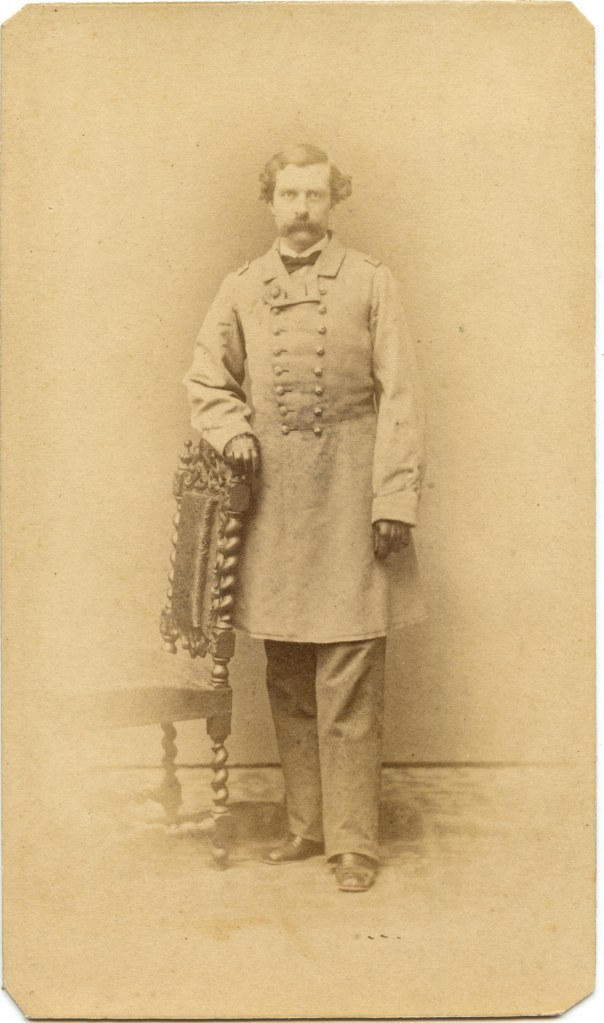
Carte-de-visite by photographer Penabert, Paris, France, taken circa 1864-1865 and inscribed to his future wife, Agnes Muse.
—————————-
Born in Virginia in 1836, this Samuel Barron would be the fifth by that same name in a long line of Barron family members committed to naval service.
His father, Samuel Barron (1809-1888) served as Commodore in both the U.S. and C.S. Navy. His grandfather, Samuel Barron (1765-1810), fought as a junior officer in the American Revolution and later rose through the ranks of the new U.S. Navy, concluding his career as a Commodore. His grand-uncle, James Barron (1769-1851), was another Commodore and the most senior member of the U.S. Navy upon his death in 1851. And finally, his great-grandfather, James Barron (1740-1787) served as Commodore of the small Virginia state navy during the American Revolution.
From his obituary in The Norfolk Landmark, Barron was described as “…conceived and nourished in a fondness for the sea, which was gratified at the early age of 16, when he went to the East Indies as cabin boy and returned as first mate, the trip lasting three years. After cruising all over the world, he, about the year 1855, began life anew on a cattle ranch in Brazil from which place he soon drifted to California and was there at the breaking out of the Civil War. When the news reached him, together with… George E. Pickett… he started for the Confederacy, and their experience and thrilling escapes from capture would read more like romance than facts.”
Upon arrival in Richmond, Barron was appointed Acting Master, and assigned to the C.S.S. Jamestown, in which he served during the battle of Hampton Roads (March 8-9, 1862), and on the C.S.S. Beaufort (renamed Roanoke) during the battle of Drewry’s Bluff (May 1862), and with the James River Squadron.
Barron was promoted to Lieutenant in February 1863, and 1st Lieutenant in January 1864, during which he spent most of his time in “service abroad” on behalf of the Confederate States Navy. This included work under his father in Europe, who was coordinating a variety of naval support efforts alongside Commander James D. Bulloch. During this time, the younger Barron aided in cruises of the C.S.S. Florida and C.S.S. Stonewall.
At the conclusion of the War, Barron traveled abroad, spending significant time in Mexico before returning to the United States in 1868. He married and settled back in his native Virginia, farming and later operating a ship brokerage company. In 1892, he died at the age of 56, following complications from a stroke. He is buried at St. John’s Episcopal Church, Warsaw, Essex County, Virginia, beside his wife and a number of other members of his immediate family.
Image: Carte-de-visite by photographer Penabert, Paris, France, taken circa 1864-1865 and inscribed to his future wife, Agnes Muse. Provenance: Barron family; former Bill Turner collection; courtesy of the collection of Fred D. Taylor.
 Fred~on~History