by Fred D. Taylor, originally published November 2005 in the Suffolk News-Herald; updated November 2015.

As Thanksgiving is just days away, I decided to change the pace away from simply discussing someone of local significance or an historic battle, and talk a little about the history of the first English Thanksgiving in America.
While most school children in the last few weeks have been performing plays celebrating that spectacular gathering between the Pilgrims and the Indians, the truth of the matter is they got it all wrong. Gasp! Yes, I’m here popping the bubble of all the little kids who dressed up in their pilgrim hats and buckled shoes, or Indian headdresses, to tell the story the history books didn’t want them to know…
Despite popular American nostalgia that the first Thanksgiving was held by the Pilgrims after the arrival of the Mayflower at Plymouth Rock, it actually had its beginnings just a few miles from us along the James River at present-day Berkeley (pronounced Bark-lee) Plantation in Charles City County.
The year was 1619, twelve years after the establishment of Jamestown, when a group of thirty-eight settlers aboard the ship Margaret arrived after having made a ten-week journey across the Atlantic. Upon their landing, they knelt and prayed on the rich Tidewater soil, with their Captain John Woodlief proclaiming:
“Wee ordaine that the day of our ships arrivall at the place assigned for plantacion in the land of Virginia shall be yearly and perpetually keept holy as a day of thanksgiving to Almighty God.”
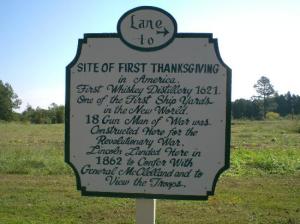
As historically recorded, this event was the first English Thanksgiving in the New World. So why the big deal about the Pilgrims and the first Thanksgiving being at Plymouth Rock? Good question. Some historians follow the trail to northern-written textbooks (after the War Between the States, of course), but even then anything more than a cursory study of colonial history will lead one to the discrepancy between the dates of the first Thanksgiving. Yet, we continue today to recognize the Plymouth Thanksgiving as the first, despite the clear evidence to the contrary. In fact, the irony of all ironies is that not only did Virginia’s Thanksgiving celebration occur before the one in Massachusetts, the Pilgrims had not even landed in America yet! The Pilgrims arrival would come one year and seventeen days later in 1620, and their Thanksgiving celebration nearly two years later in 1621.
Celebrations of “thanksgiving” would become a deeply rooted American tradition though, usually brought on by periods of great hardship. During the American Revolution, the Continental Congress proclaimed days of Thanksgiving every year from 1778 to 1784. Likewise, George Washington issued the first Presidential proclamation of Thanksgiving in 1789, and a few of his successors followed suit. Interestingly, Thanksgiving was not a specific day or even month, and apparently was issued on the whim of whoever was in office. Sporadically between the years 1789 and 1815, days of Thanksgiving were recognized in January, March, April, October, and November. This recognition of Thanksgiving ended in 1815 following the term of President James Madison, and a President would not issue such a proclamation for another forty-six years.
That President was Jefferson F. Davis, who recognized a day of thanks, humiliation, and prayer for the young Confederate States of America for October 31st, 1861. Not to be outdone, President Abraham Lincoln resurrected the forgotten day in the United States as well, and issued a similar proclamation in April of 1862. In 1863, Thanksgiving was made a national holiday, and in 1866, the tradition of recognizing Thanksgiving on the fourth Thursday of November was started by President Andrew Johnson.
From that time on, every sitting President has recognized Thanksgiving as a national holiday. Nonetheless, the twists in the story continue. While the recognition of the holiday has been uninterrupted since 1861, the explanations of the origins of Thanksgiving have been numerous. For years, the residents of the Oval Office ignored Virginia’s claim to the first Thanksgiving, but that all changed in 1963. It took a Massachusetts Yankee by the name of John F. Kennedy to take the risk of alienating his constituency back home to tell the rest of the story. President Kennedy honored Massachusetts’s and Virginia’s claim in his proclamations of 1963 at the urgency of his Special Assistant Arthur M. Schlesinger, Jr., a noted historian and political scientist. After Kennedy’s death, President Johnson mentioned Virginia twice, President Jimmy Carter recognized it in 1979, and the last to recognize Virginia’s claim was President Ronald Reagan in 1985.
Today, the struggle to tell the true story of Thanksgiving continues in classrooms across America, and even more so here at home in Virginia where it all started. For several years now, a group of concerned citizens have organized an annual event to celebrate the First Thanksgiving at Berkeley, and each year they recreate that historic event on the shores of the James River.
In the wake of America’s 400th Anniversary in 2007, the necessity to tell the real Thanksgiving story is all the more important. So as you prepare for Thanksgiving this year, take a few minutes to reflect on this story, and to pass this tidbit of history along to others. Every little bit helps in getting the truth out. As for me this year, I’ve certainly got plenty to be thankful for, but in honour of those courageous thirty-eight who arrived on the shores of Virginia in 1619, I’ll be substituting my turkey and stuffing for Smithfield Ham and Chesapeake Bay Oysters.


