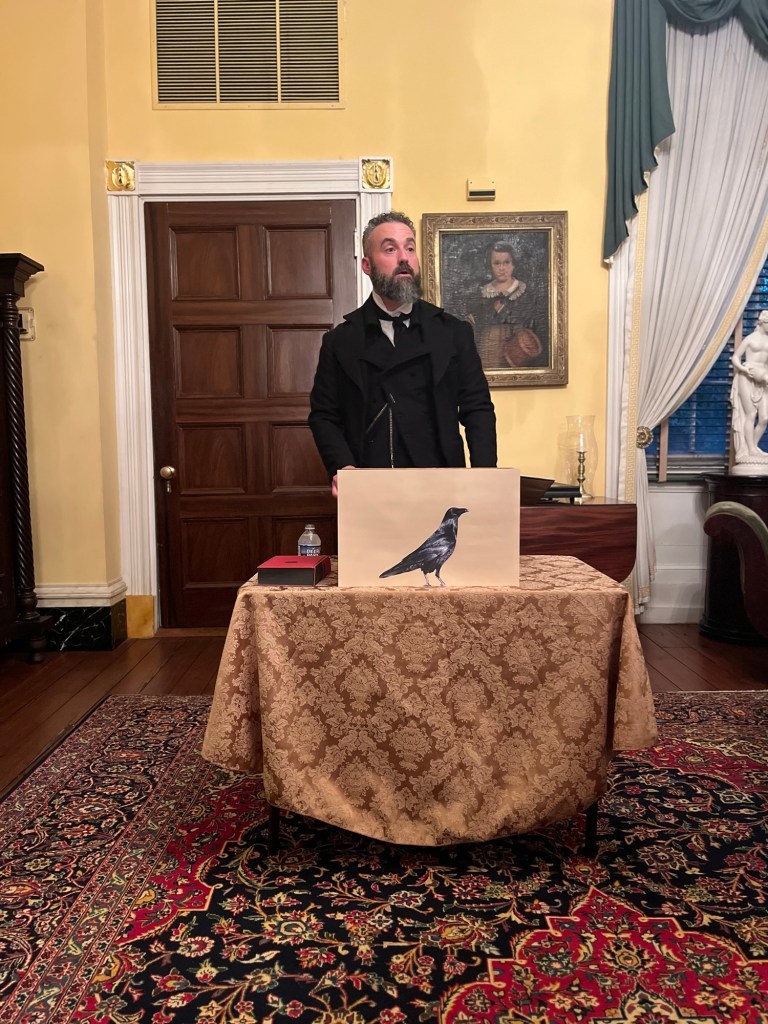
Some people travel hundreds of miles to experience history. Around Chuckatuck, we only have to look across the creek.
From our home on Cedar Creek, we can look toward Mattanock Town, the ancestral home of the Nansemond Indian Nation. It’s a reminder that long before Suffolk existed — long before Virginia appeared on a map — this land was home to the Nansemond people, whose name means “fishing point.” For thousands of years, they lived along the Nansemond River, fishing its waters, harvesting oysters, hunting its forests, and farming its fertile shores.
English settlement though brought warfare, displacement, and centuries of pressure to abandon their identity. Nevertheless, the Nansemond endured — maintaining their families, their community, and their connection to this land through an unlikely marriage between a 17th century English minister and the daughter of a Nansemond Chief. Today, they remain an important part of our community — not just a chapter in a history book, but our neighbors.
My own appreciation for their story began when I was young. My father shared his fascination with local history after spending his childhood walking freshly plowed fields, finding arrowheads left behind by those who called this place home generations before us. Those small discoveries sparked a lifelong respect for the people who came before us.
One memory has stayed with me for decades: meeting Chief Earl “Running Deer” Bass at a Nansemond Pow Wow. I was just a kid, and he was already in his 80s, but I remember him as a kind, gentle soul – and a man who loved Christ. He was fiercely proud of his Nansemond heritage and of his Christian faith — an example that has stayed with me.
In 1988, the tribe held its first Pow Wow back on their ancestral land, calling it the “Nansemond Indian Homecoming.” This weekend, that history comes alive once again as the 38th Annual Nansemond Indian Pow Wow returns to Mattanock Town. Gates open at 10 a.m. on Saturday and Sunday, with Grand Entry at noon on Saturday and 1 PM on Sunday. Visitors can experience traditional dancing and singing, Native arts and crafts, food, fellowship, and opportunities to learn about one of Virginia’s oldest living cultures. Admission and parking are free, though donations are encouraged to support the tribe’s ongoing work.
If you’ve never been, I encourage you to go. It’s a chance to celebrate a people whose story has never ended, and whose roots remain firmly planted right here in our backyard.
Sometimes the richest history isn’t found in a museum. Sometimes, it’s just across the creek. From our Chuckatuck porch where we can still hear the drumbeats of the Nansemond, until next time, that’s another Fred On History Friday.
This has been a tough week, and leaving me further heartbroken is hearing the passing of my friend, Ben Jones.
To millions of people, Ben was Ben Jones aka “Cooter” from The Dukes of Hazzard—a beloved character whose humor, warmth, and unmistakable voice became part of American popular culture. But to those of us who were fortunate enough to know him personally, Ben was so much more. He was a man of conviction and compassion, a gifted storyteller, a loyal friend, and a genuinely kind and gracious human being.
Ben and I first met in 2001, in what now seems like another lifetime. We became unlikely allies in the world of politics. Ben had served as a Democratic member of Congress and, with his characteristic self-deprecating humor, liked to say that he lost reelection because of an illness: “The voters were sick and tired of me.”
That was Ben. He could find the humor in almost anything, including himself. But beneath the laughter was an intelligent, thoughtful man who cared deeply about his country, his history, his friends, and the causes to which he committed himself.
Although politics first brought us together, we soon discovered that we shared common ground in many other ways. We both had a deep affection for North Carolina and Virginia, as Ben was born in eastern NC, but the railroad brought his family to Tidewater while he was still young. He spent a great deal of time in Suffolk, particularly in Driver, where his grandparents lived.
Ben eventually graduated from Woodrow Wilson High School in Portsmouth, before attending the University of North Carolina, where he studied theatre. From there, of course, his journey carried him into acting, music, television, public service, and a place in the hearts of generations of fans.
When Ben and I met, questions surrounding Southern history and heritage were becoming increasingly contentious in Virginia. From that beginning grew a lasting friendship. Together, we lobbied legislators and governors, gave television and newspaper interviews, attended meetings, and spent more hours than I can count talking about history, politics, people, and life.
At the time, I was making my way through college and then law school, while Ben was managing his Cooter’s establishments in Tennessee and Virginia. Our lives were busy, and often very different, but the friendship endured.
After the political tempests of those years had settled, Ben and I continued to reunite from time to time. We saw one another at memorial services and community events, including Driver Days, where Ben and his band appeared on several occasions. Anyone who saw Ben perform knew that he did not merely entertain an audience—he embraced it. He made people feel that they were part of the show and, for a little while, part of his extended family.
One reunion that remains especially vivid in my memory came when Ben was promoting his autobiography at Prince Books in Norfolk. I had the privilege of introducing him to my father and having him sign one of his books. I also had the opportunity to see Ben in a very different and touching setting, surrounded by many of his former high school classmates who had come to see him.
Here was a man who had achieved national fame, served in Congress, appeared before countless cameras, and met people from every walk of life. Yet among his old classmates, he was simply Ben again—the young man they had known in Portsmouth. There was no pretense about him. No sense that celebrity had placed him above anyone else.
There was always a smile on Ben’s face and laughter in his voice, but it was never merely part of a character he played. That warmth was real. His kindness was real. His graciousness was real.
Ben was a true Southern gentleman in the very best sense of that phrase: courteous, generous, loyal, welcoming, and attentive to the people around him. Whether he was speaking to a governor, an old school friend, a fan of The Dukes of Hazzard, or someone he had met only moments before, Ben had a gift for making that person feel seen and valued.
We connected again in 2015, when we worked together during his service as spokesman for the Sons of Confederate Veterans. As before, Ben approached that work with passion, determination, and a deep sense of personal conviction.
During the last few years, distance and the demands of life meant that we did not see one another as often as we once had. But we remained in touch through emails and Christmas cards. Ben would keep me informed about the latest news from “Hazzard County,” and I would send him reports from “old Nansemond.”
And whenever I called, Ben would answer.
More than once, I handed the telephone to an unsuspecting friend. A moment later, that friend would hear the unmistakable voice on the other end of the line: “This is Crazy Cooter comin’ at ya…”
The surprise and delight on their faces never failed to make me laugh, and Ben was always willing to play along. It was a small kindness, perhaps, but it said a great deal about him. Ben understood the joy he could bring to people, and he gave that joy freely.
I will miss those telephone calls. I will miss the correspondence. I will miss the laughter, the stories, the shared memories, and the knowledge that somewhere up the road, my old friend Ben was still holding forth in Hazzard County.
I will remember with gratitude the years we shared, the causes we championed, the places we visited, and the conversations that passed between us. I will remember his courage, his humor, his loyalty, and his compassion for so many people and so many causes.
Most of all, I will remember the man behind the famous character: my friend Ben Jones.
My deepest condolences go to his dear wife, Miz Alma—his true love, his partner, and his best friend. May she, their family, and all those who loved Ben find comfort in the extraordinary life he lived, the countless lives he touched, and the joy he gave so generously to others.
And somewhere in my memory, I will always hear that familiar voice coming across the telephone, full of mischief, laughter, and life: “This is Crazy Cooter comin’ at ya…”
Rest in peace, old friend, and may you continue on to rise in Glory.
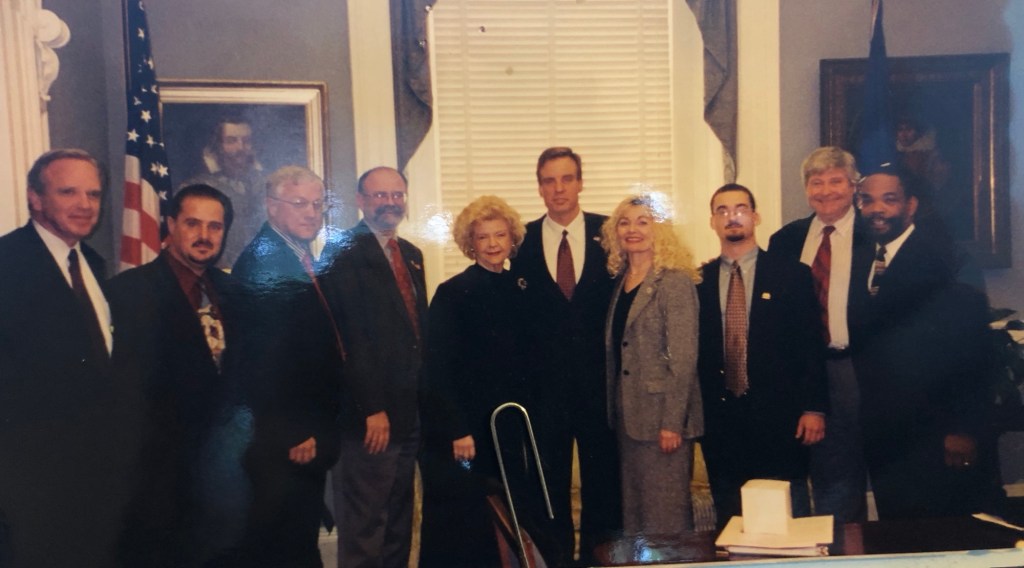
Circa 2002 at the Virginia Capitol during a meeting with then-Governor Mark Warner, with Ben by my side. We made a formidable team.
Most folks have heard of Pickett’s Charge and the battle of Gettysburg. Fewer know that one of the family stories connected to that famous moment in American history runs right through Chuckatuck.
Meet James Jasper Phillips.
Born in Nansemond County in 1832, Phillips came from a local family tied to the Chuckatuck area. After graduating from the Virginia Military Institute in 1853 — ranked near the top of his class — he returned home and became an educator.
In 1854, he helped establish what became known as the Chuckatuck Military Academy, also remembered as the Chuckatuck Male and Female Institute. Imagine that for a moment: before public schools as we know them today, Chuckatuck had its own school, led by a young VMI-trained teacher, with boys and girls receiving an education right here in the community.
But history soon came calling.
When the War Between the States began, Phillips helped organize the Chuckatuck Light Artillery, a local company of men from this area. Despite the name though, the unit became Company F of the 9th Virginia Infantry. Phillips was elected captain, later rose to colonel, and served through some of the hardest fighting of the war. He was wounded at Gettysburg during Pickett’s Charge, and was later captured at Sailor’s Creek just days before the surrender at Appomattox.
And here is where the family story becomes even more interesting…
James Jasper Phillips was actually the uncle of LaSalle “Sallie” Corbell Pickett, the Chuckatuck-born wife of General George E. Pickett! (… their story will definitely be a future post!) Through the Phillips and Corbell families, our little corner of Nansemond County had a direct family connection to one of the most famous names and moments of the Civil War.
That is what makes local history so powerful.
The great events of history may be remembered in capitals, battlefields, and textbooks — but they were lived by real people from real places. Sometimes, those places are closer than we realize.
Chuckatuck has always been more than a spot on the map. It has been a crossroads of families, faith, education, service, hardship, memory, and story.
And James Jasper Phillips is one of those stories worth remembering.
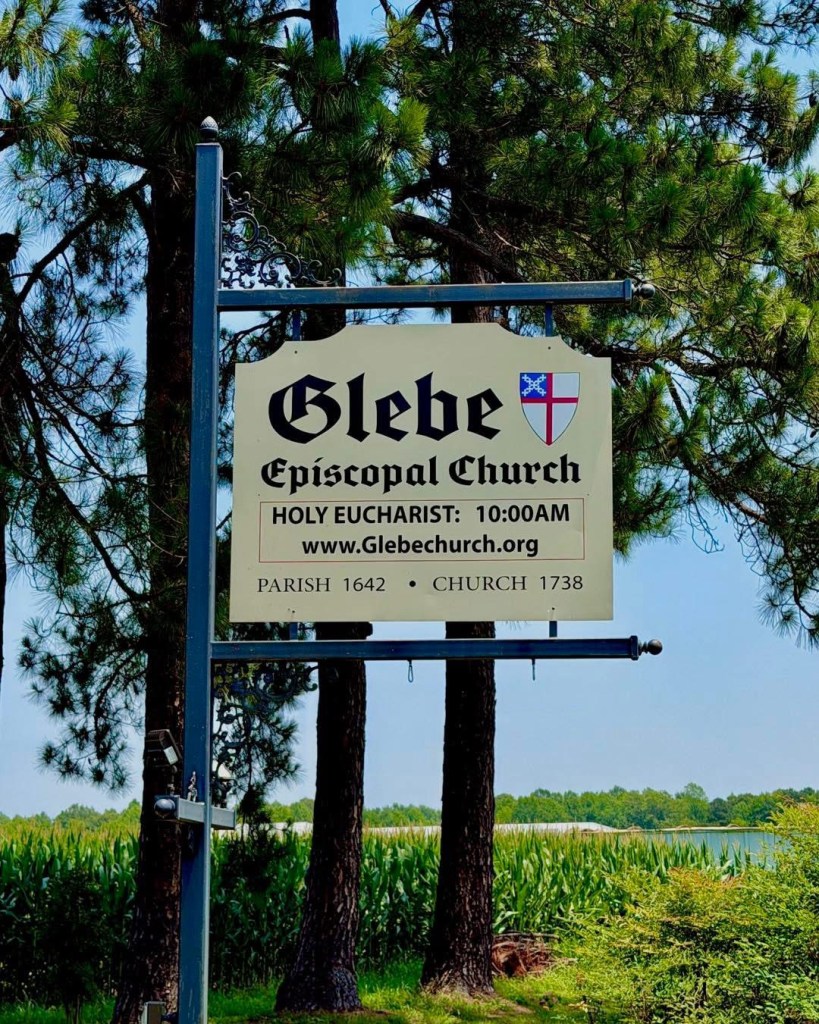
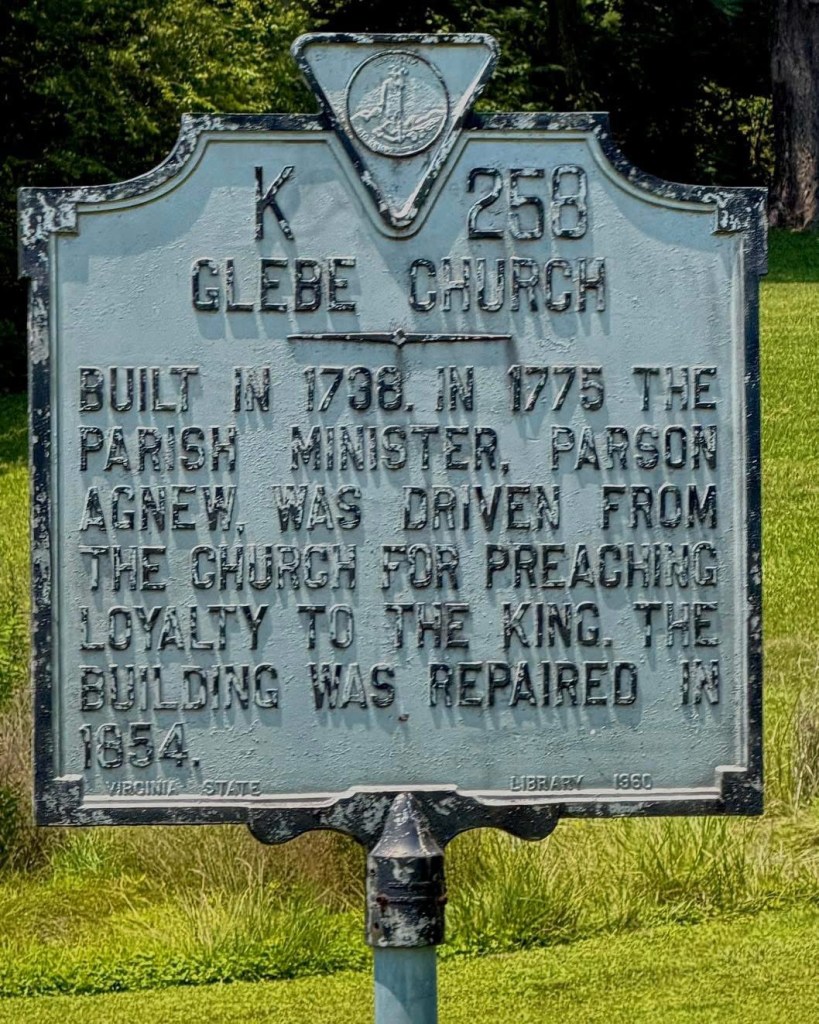
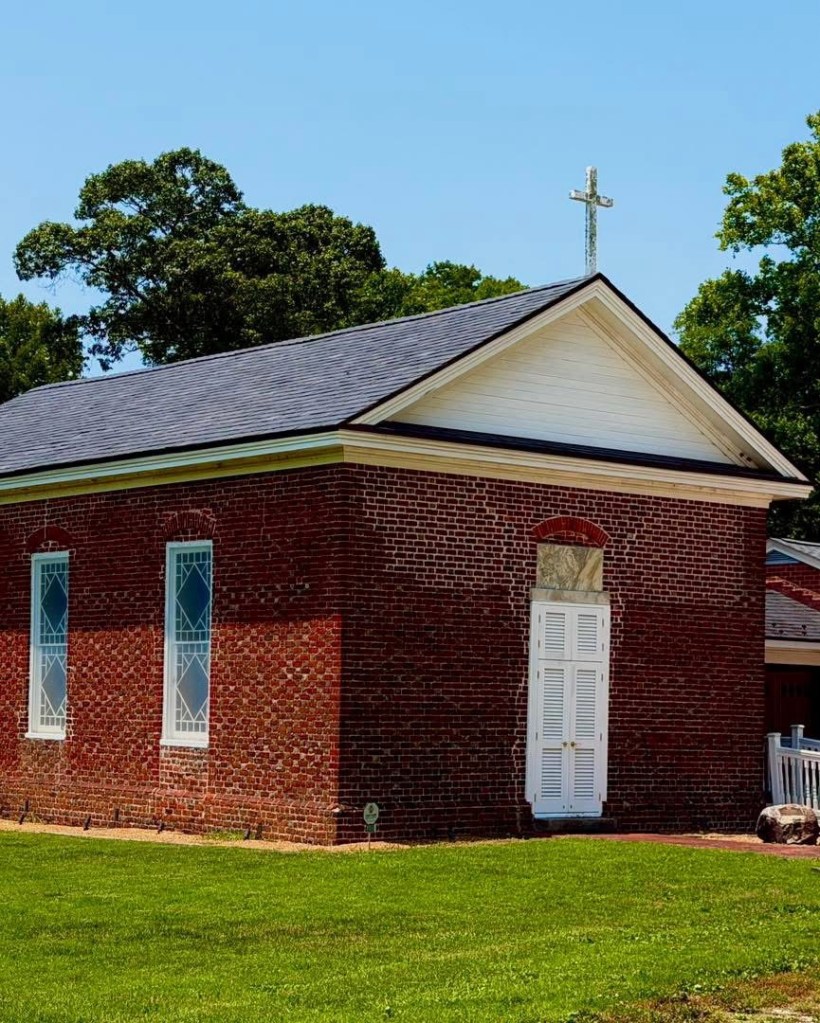
Last week, we talked about the “original” King’s Highway. And along that same old road, in what is now the Driver community, stands Glebe Church originally known as the Bennett’s Creek or “Lower Parish” Church, a historic place where local life and revolutionary feeling collided.
Interestingly, Glebe Church has a direct connection to Chuckatuck. Because of the lack of clergy, particularly in rural areas during colonial times, the minister at Glebe Church – the Rev. John Agnew – also served as minister at St. John’s Church in the Chuckatuck Parish. So, this isn’t the story of some distant colonial minister. It’s the story of a man whose ministry reached into Chuckatuck and whose choices reflected the divisions of the Revolution.
In 1775, with revolutionary feeling rising across Virginia, Agnew stepped into the pulpit at Glebe Church to influence his flock. As an Anglican clergyman, he was loyal to the Crown, and on this particular Sunday he took as his text the words of Jesus: “Render unto Caesar the things that are Caesar’s.” But the congregation knew where he was headed.
Agnew began his preaching, warning against disloyalty to lawful government — and in his view, disloyalty to the King. But before he could finish, William Cowper, a local vestryman and magistrate, stood and ordered him down from the pulpit.
Agnew reportedly replied, “I am doing my Master’s business.”
Cowper answered with the question that captured the Revolution: “Which master? Your Master in heaven, or your master over the seas?”
That question would mark the conclusion of the sermon. Agnew walked out of the Church that day, never returning.
During the War, Rev. Agnew left Virginia, casting his lot fully with the Loyalist cause. He served as a Chaplain with the “Queen’s Rangers,” a regiment in which his son was serving as an officer. In 1781, both father and son were captured by a French squadron while aboard the British frigate Romulus. They would be imprisoned for the remainder of the war in Rhode Island, Saint-Domingue — present-day Haiti.
Of course, because of the Colonies’ success, the Agnews found that the old world they had known was gone. They were unwelcome to return to Virginia and the new American republic, so they returned to England. But Rev. Agnew eventually immigrated to New Brunswick, Canada, among other loyalist exiles. He lived and prospered there – serving for at least one term in their House of Parliament – until his death in 1812.
This is why local history matters. The Revolution wasn’t simply America versus Great Britain. It divided families, neighbors, congregations — even pulpits.
Along the old King’s Highway in Chuckatuck and Nansemond County, people faced the same question that echoed across the colonies: When Caesar and conscience collide, who gets the final word?
As we remember America’s 250th Anniversary, stories like this remind us that independence wasn’t only declared in Philadelphia on July 4th — it was lived, debated, and defended here at home, along the roads, in the churches, and among the people who would help shape a new nation.
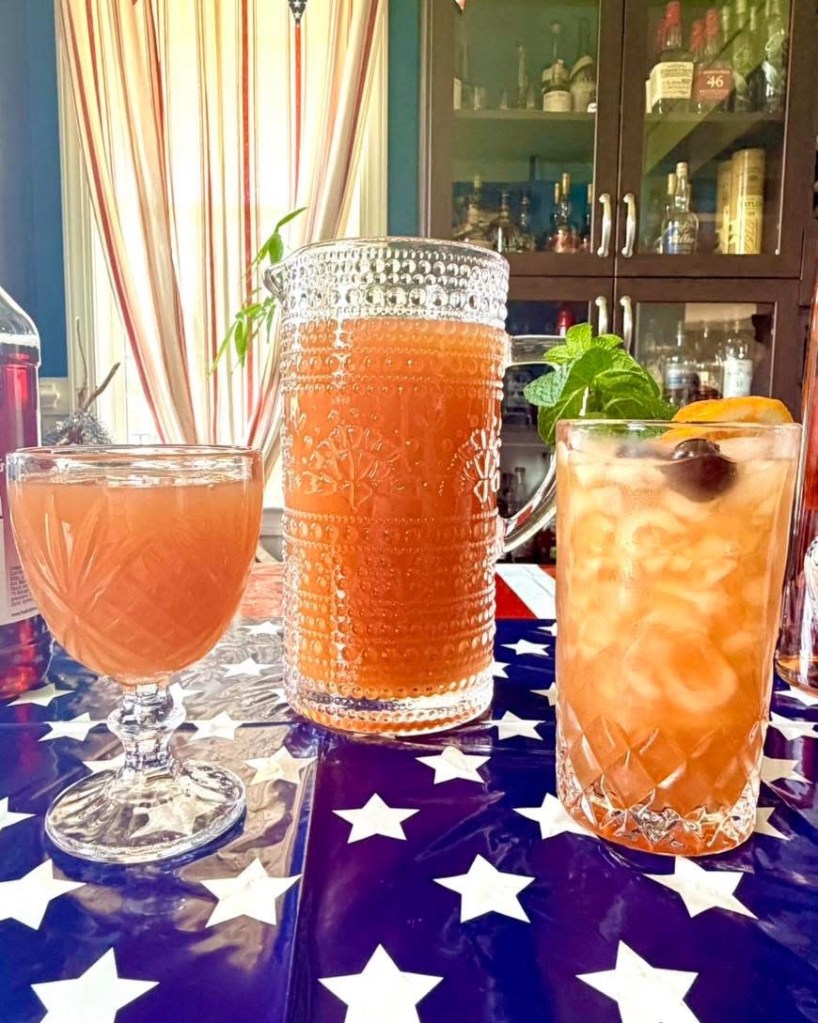
As we celebrate the Fourth of July, it seems only fitting to raise a glass to one of colonial America’s favorite traditions: rum punch.
Long before the modern cocktail bar, punch was the drink of fellowship — served in bowls, ladled into cups, and shared at taverns, homes, public gatherings, and celebrations. Rum was one of the great spirits of the Atlantic world, connecting the colonies with the Caribbean through trade, taste, and hospitality.
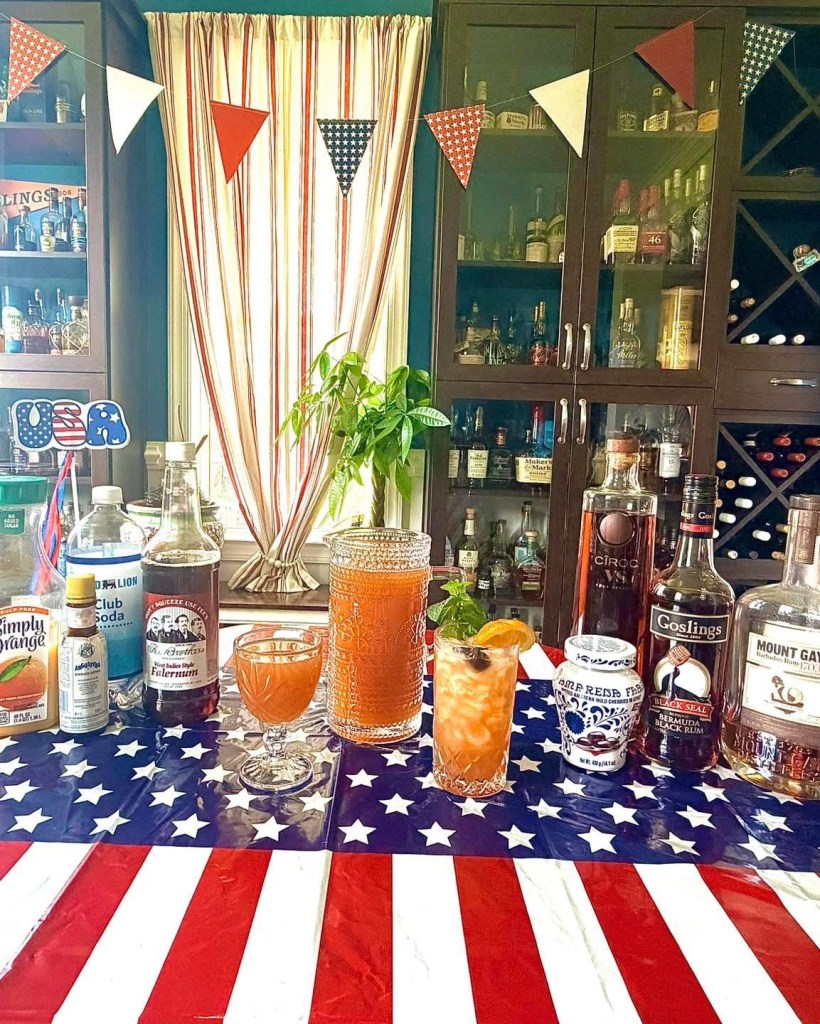
This “Chuckatuck Punch” is my version of that old tradition. It leans into Bermuda (surprise!) with Gosling’s Black Seal Rum, nods to the broader Caribbean with Barbados rum and falernum, and brings in the classic punch elements of citrus, spice, fruit, and a finishing touch of brandy.
Think of it as 18th-century punch bowl tradition meets a summer party — perfect for America 250, or any summer gathering worth remembering.
Chuckatuck Punch Recipe
Serves about 12
Ingredients
1 ½ cups Gosling’s Black Seal Rum 1 ½ cups Barbados rum or another quality amber/gold rum ⅜ cup falernum (Goslings or Fee Brothers) same as 6 tablespoons or 3 ounces 1 cup fresh lime juice (or half lime & lemon) 1 ½ cups orange (or pineapple) juice 8 dashes Angostura bitters 2 ounces good quality brandy same as ¼ cup or 4 tablespoons 2 ounces cherry juice and/or grenadine, to taste Soda water, to top Orange slices, fresh mint and your favorite cherries for garnish Crushed ice Directions
In a large pitcher or drink dispenser, combine the Gosling’s Black Seal Rum, Barbados rum, falernum, fresh lime juice, orange juice, and Angostura bitters.
Stir well and chill until ready to serve.
To serve, fill tall glasses with crushed ice. Pour the punch over the ice, top each glass with soda water, garnish with orange slices, mint & cherries, and finish each serving with a small splash — about 1 teaspoon — of brandy.
So, as we look back 250 years toward the founding generation, “Chuckatuck Punch” offers a small taste of the kind of shared hospitality that would have been familiar in colonial America — bold, bright, convivial, and made for passing around.
Until next time, from our Chuckatuck porch to yours, cheers! 🍹
Most people driving through Chuckatuck today have no idea they may be traveling over a road system older than our country itself.
Long before there was a State Route 10 or 125, or even a good ol’ U.S. of A., this part of Virginia was tied into what was known in colonial times as King (Charles II’s) Highway.
But the story starts even earlier than that.
Many of Virginia’s early roads followed older American Indian paths — trails that crossed rivers and creeks at the narrowest, most practical points. As English settlers arrived in the 1600s, those paths slowly became primary roads, mail routes, ferry routes, and eventually pieces of a larger highway system connecting communities across the colonies.
By the 1700s, the “King’s Highway” stretched in various forms for more than 1,300 miles, linking Boston, Massachusetts, to Charleston, South Carolina. And here in Tidewater, that route helped connect travelers moving between Richmond and Petersburg east to Suffolk, Portsmouth/Norfolk, and onward into North Carolina.
That made Chuckatuck more than just a quiet village. It made Chuckatuck a crossroads within a much larger network of travel.
Because of its location near both the Nansemond River and Chuckatuck Creek, this area became important for farming, trade, and transportation. Tobacco, corn, cotton, livestock, supplies, mail, merchants, soldiers, and the like all moved through here.
And one of the most important local connections along the King’s Highway was of course, Sleepy Hole Ferry.
Before modern bridges, ferries were lifelines. Sleepy Hole Ferry connected both sides of the Nansemond River and served as a critical crossing point for travelers, commerce, and — at times — armies.
Speaking of, during the American Revolution, Benedict Arnold’s British troops crossed near Sleepy Hole Ferry in January of 1781, as they were returning from a raid on Richmond. Famed Continental General Marquis de Lafayette would do the same, chasing after Arnold. And later that same year, British Commanding General Cornwallis crossed on the Sleep Hole Ferry on his way toward Portsmouth.
Think about that for a second.
British and Continental troops moving through this area — right here near Chuckatuck — during the fight for American independence.
That is what makes local history so fascinating.
History did not only happen in Boston, Philadelphia, Williamsburg, or Yorktown.
It happened along quiet roads. It happened at ferry crossings.
It happened in small communities like Chuckatuck that helped connect early America together.
And as we approach America’s 250th birthday, roads like the King’s Highway remind us that the story of America runs not just through the major cities or battlefields that make the history books, but through the places we pass by every day.
Even right here at home.
So from my porch to yours — cheers to more local history, until the next time!
Image: Excerpt from Map of Isle of Wight and part of Nansemond, made under the direction of A.H. Campbell and J.F. Gilmer, Chief Engineer’s Office, Army of Northern Virginia, 1864. Courtesy of the Archives of the United States Military Academy.
Adrienne and I are excited to share something we’ve been working on — our new blog, The Chuckatuck Life 🪴
It’s a space where we’ll be honoring traditions passed down through generations while creating new ones worth holding onto, and celebrating the everyday moments that make life in and around Chuckatuck so special. Think homemade recipes, seasonal traditions, local history, and a little bit of small-town charm along the way.
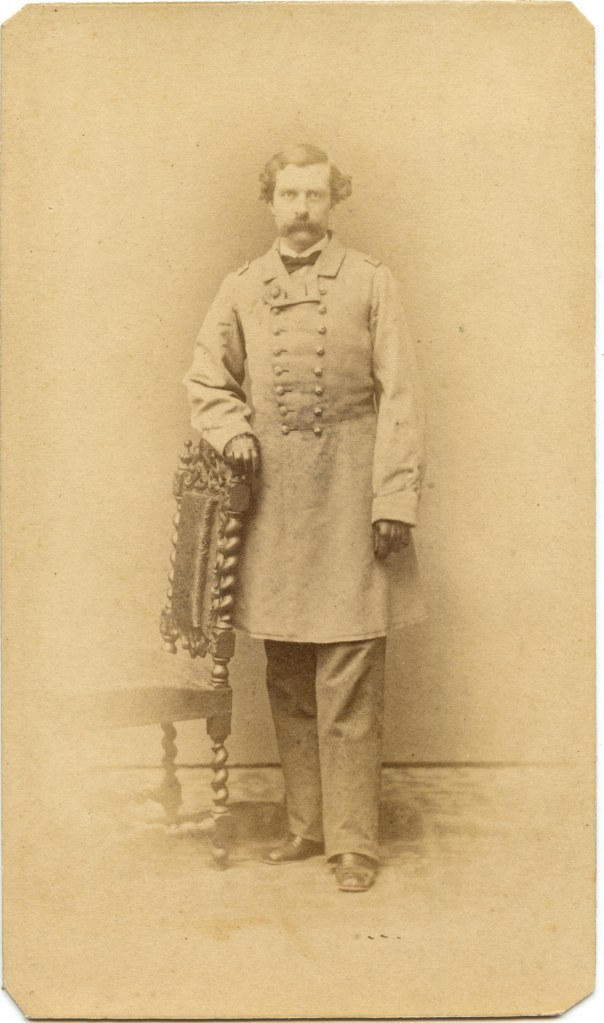
Samuel Barron Carte-de-visite by photographer Penabert, Paris, France, taken circa 1864-1865 and inscribed to his future wife, Agnes Muse.
—————————-
Born in Virginia in 1836, this Samuel Barron would be the fifth by that same name in a long line of Barron family members committed to naval service.
His father, Samuel Barron (1809-1888) served as Commodore in both the U.S. and C.S. Navy. His grandfather, Samuel Barron (1765-1810), fought as a junior officer in the American Revolution and later rose through the ranks of the new U.S. Navy, concluding his career as a Commodore. His grand-uncle, James Barron (1769-1851), was another Commodore and the most senior member of the U.S. Navy upon his death in 1851. And finally, his great-grandfather, James Barron (1740-1787) served as Commodore of the small Virginia state navy during the American Revolution.
From his obituary in The Norfolk Landmark, Barron was described as “…conceived and nourished in a fondness for the sea, which was gratified at the early age of 16, when he went to the East Indies as cabin boy and returned as first mate, the trip lasting three years. After cruising all over the world, he, about the year 1855, began life anew on a cattle ranch in Brazil from which place he soon drifted to California and was there at the breaking out of the Civil War. When the news reached him, together with… George E. Pickett… he started for the Confederacy, and their experience and thrilling escapes from capture would read more like romance than facts.”
Upon arrival in Richmond, Barron was appointed Acting Master, and assigned to the C.S.S. Jamestown, in which he served during the battle of Hampton Roads (March 8-9, 1862), and on the C.S.S. Beaufort (renamed Roanoke) during the battle of Drewry’s Bluff (May 1862), and with the James River Squadron.
Barron was promoted to Lieutenant in February 1863, and 1st Lieutenant in January 1864, during which he spent most of his time in “service abroad” on behalf of the Confederate States Navy. This included work under his father in Europe, who was coordinating a variety of naval support efforts alongside Commander James D. Bulloch. During this time, the younger Barron aided in cruises of the C.S.S. Florida and C.S.S. Stonewall.
At the conclusion of the War, Barron traveled abroad, spending significant time in Mexico before returning to the United States in 1868. He married and settled back in his native Virginia, farming and later operating a ship brokerage company. In 1892, he died at the age of 56, following complications from a stroke. He is buried at St. John’s Episcopal Church, Warsaw, Essex County, Virginia, beside his wife and a number of other members of his immediate family.
Image: Carte-de-visite by photographer Penabert, Paris, France, taken circa 1864-1865 and inscribed to his future wife, Agnes Muse. Provenance: Barron family; former Bill Turner collection; courtesy of the collection of Fred D. Taylor.