July 2, 1863

Yesterday’s #fredonhistory post got a lot of comments, so here we go remembering day 2 of Gettysburg, with two images featuring officers of the 33rd North Carolina, one of whom fell on the field that day…

When North Carolina seceded in May of 1861, forty-three year old attorney Tod Robinson Caldwell of Morganton held strong to his allegiance to the Union. A five time member of the North Carolina General Assembly, Caldwell was said to be an old line, “Henry Clay Whig,” who could not support secession.

Without a doubt then, he also hoped his teenaged son, John “Jack” Caldwell, would do the same. Young Jack was a Cadet at the Hillsboro Military Academy at the time though, and it did not take long for him to cast his lot with the South. By September of 1861, Caldwell was serving as a 2nd Class Drill Instructor for the state of North Carolina in training camps in and around Asheville. He continued in this capacity through 1862, until most of the volunteer regiments had organized and marched off.

Cadet John “Jack” Caldwell,
Hillsboro Military Academy

Reaching the age of 18 and longing to command in the field, Jack Caldwell called on his old family friend and neighbor, Colonel Clarke Moulton Avery, commander of the 33rd North Carolina Troops. When Caldwell reached the regiment in early May 1863, the 33rd (a part of Lane’s Brigade) was in action at the battle of Chancellorsville. That same day Caldwell was appointed to serve as a 2nd Lieutenant in Company E of the 33rd.

After receiving his baptism under fire at Chancellorsville, young Lieutenant Caldwell marched northward with the 33rd North Carolina in Lee’s second invasion of the north. The result was the battle of Gettysburg.

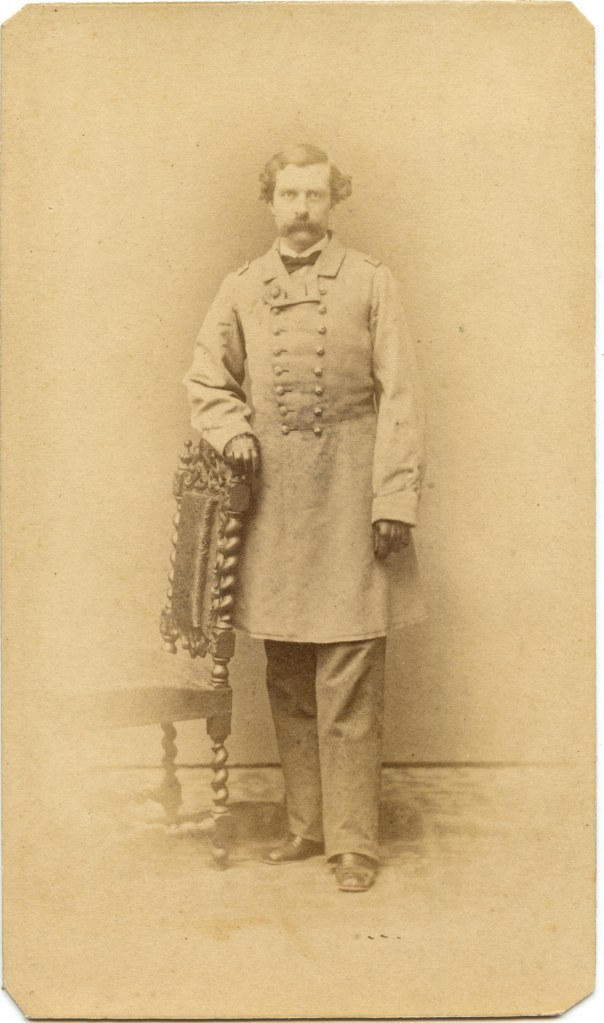
Colonel Clarke Moulton Avery
33rd North Carolina Troops

On the second day of the battle, Major General William Dorsey Pender called on the 33rd for volunteers to challenge a line of Yankee skirmishers who were wreaking havoc on their front. Seventy-five volunteered and were placed under the command of Lt. Wilson Lucas and Lt. Jack Caldwell. Lucas recalled Pender asking, “Can you take that road in front? If you can’t take it say so, and I will get someone who can.” Lucas responded, “We can take it if any other 75 men in the army of Northern Virginia can.” Lucas went on to describe:

“We formed the men in line, I commanded the right and Lieut. Caldwell the left. We had to charge through an open field, with no protection whatever… When we got within two hundred yards of the Federals, we charged with a yell, and they stood their ground until we were within ten steps of the road, then a part of them ran, but 26 surrendered. And the very last time they fired upon us, which was not more than twelve or fourteen feet from them, they shot Lieut. Caldwell in the left breast. I did not see him fall. As soon as we were in the road one of the men told me Lieut. Caldwell was killed. I went at once to the left and found him, lying partly on his back and side… I called two men, and we placed him on his back and spread his oil cloth over him. He was warm and bleeding very freely when I got to him. I could not send him out to the regiment, for it was such an exposed place the Federal skirmishers would have killed a man before he could get a hundred yards, as we were lying close to each other.”

As a result of his courage that day, Lt. Caldwell was recognized by his comrades on North Carolina’s Roll of Honor.

Following the engagement , Caldwell’s body was safely recovered and his remains returned home, where he is buried at the Forest Hill Cemetery in Morganton.

I should also add, Caldwell’s father went on to become Lieutenant Governor and Governor during the Reconstruction period in North Carolina.

Images:

1/4 plate tintype of John “Jack” Caldwell as a Cadet at the Hillsboro Military Academy. Courtesy of the Brem Family.

Carte-de-visite of Colonel Clarke Moulton Avery, M. Witt’s Photograph Gallery, Columbus, Ohio. Taken while prisoner of war at Johnson’s Island, 1862. Courtesy Fred D. Taylor Collection, Suffolk, Virginia.

162 Years – Remembering Day 1 of Gettysburg

A special Tuesday edition of #FredOnHistory

Without fail, the early days of July put me into a mood for history. Of course, it’s easy when remembering those three fateful days in 1863 at Gettysburg, followed by July 4th and its look back at the American Revolution / founding of the United States – now quickly approaching 250 years!

So today, it was not surprising that after a Court hearing, Archer and I spent the afternoon immersed in history, working on a conservation project and then trekking across a Richmond battlefield (more to come on those).

For July 1st though, I cannot fail to recall the brave boys of the 26th North Carolina regiment who “covered itself with glory,” under the command of their “Boy Colonel” Henry K. Burgwyn.

This brings me to a special photograph in my collection.

Charles McDowell Suddreth (also spelled Sudderth) was born on October 18, 1833, in what would become Caldwell County, North Carolina, the son of Thomas and Catherine Sudderth.

In 1856, he married Margaret E. Spainhour, and began a family, with their first child – Catherine Elizabeth – born in 1858. A second child, and mother, passed away from complications of childbirth in July of 1861.

With War now in its second year, Charles left his four year old daughter with family, and enlisted as a Private in the “Hibriten Guards,” Company F of the 26th North Carolina Troops, on March 20, 1862. He was elected second lieutenant on April 21, 1862, and promoted to first lieutenant on October 16, 1862.

When the 26th arrived on the outskirts of the town of Gettysburg in July of 1863, the regiment numbered some 800 officers and men. By the conclusion of the first day’s battle on McPherson’s Ridge, only 212 were left unhurt. As described by historian Greg Mast: “… the “Hibriten Guards” … achieved a terrible fame at the Battle of Gettysburg. During the fight against the Iron Brigade… every member of the company present was shot down: thirty-three men were killed or mortally wounded and fifty-eight were wounded. That “unparalleled loss” may be the only instance of an entire company’s being wiped out in one battle during the war.”

As for Lt. Charles M. Suddreth, he was severely wounded in the right hand. He escaped capture, however, and returned with the regiment back to Virginia, but was hospitalized. Military service records indicate he spent the majority of the fall and summer of 1863 in Richmond-area hospitals before returning to duty.

Lt. Suddreth remained with the 26th regiment through 1864, with an intermittent hospital visit in the summer, before he submitted his resignation on January 14, 1865, with a request to be allowed to return home and join one of the cavalry units defending western North Carolina. Though records are unclear whether that officially occurred, Suddreth returned home but could not escape the War. On April 15, 1865, he was captured in Lenoir, North Carolina, by Stoneman’s raiders. He was confined at Camp Chase, Ohio, and released on June 14, 1865, after taking the Oath of Allegiance.

Following his release, Suddreth started life anew, marrying Mary Elizabeth Ann “Betty” Corpening in the fall of 1865. With Betty, they raised ten children.

Suddreth went on to live a fulfilling life, farming in the Lenoir area of Caldwell County, until limited by a stroke in 1910 leaving him permanently paralyzed. He would receive a veteran’s pension from the state of North Carolina as a result of his service.

Charles McDowell Suddreth died on May 30, 1914, and was buried in the Littlejohn Church Cemetery, in Caldwell County. The Lenoir News reported:

“On last Saturday afternoon Mr. Charles M. Suddreth died at his home about five miles west of town after an illness of many months. He suffered a stroke of paralysis two or more years ago and has been an invalid ever since. He retained his mental faculties remarkably for one in his condition, but was practically unable to help himself in any way. He bore his long illness with great fortitude and resignation. He was about 75 years old and is survived by a widow and several grown children. He was a member of the Methodist Church, a modest worthy citizen, held in esteem by a large number of friends. He was one of four brothers to go through the Civil War and was a courageous soldier. The body was buried at Littlejohns Church on Monday.”

Image: Quarter plate ambrotype by an unknown photographer. This image appears to have been taken during his time as a 2nd Lieutenant, which would date the image between April-October, 1862. Suddreth is holding an Eagle-head, pre-War militia sword.

Courtesy of the Fred D. Taylor collection of “Tar Heel Faces.” For more information, see: https://tarheelfaces.omeka.net/