Good Friday, Hot Cross Buns and Bermuda

Wishing all a blessed Good Friday, and a double dose of #fredonhistory

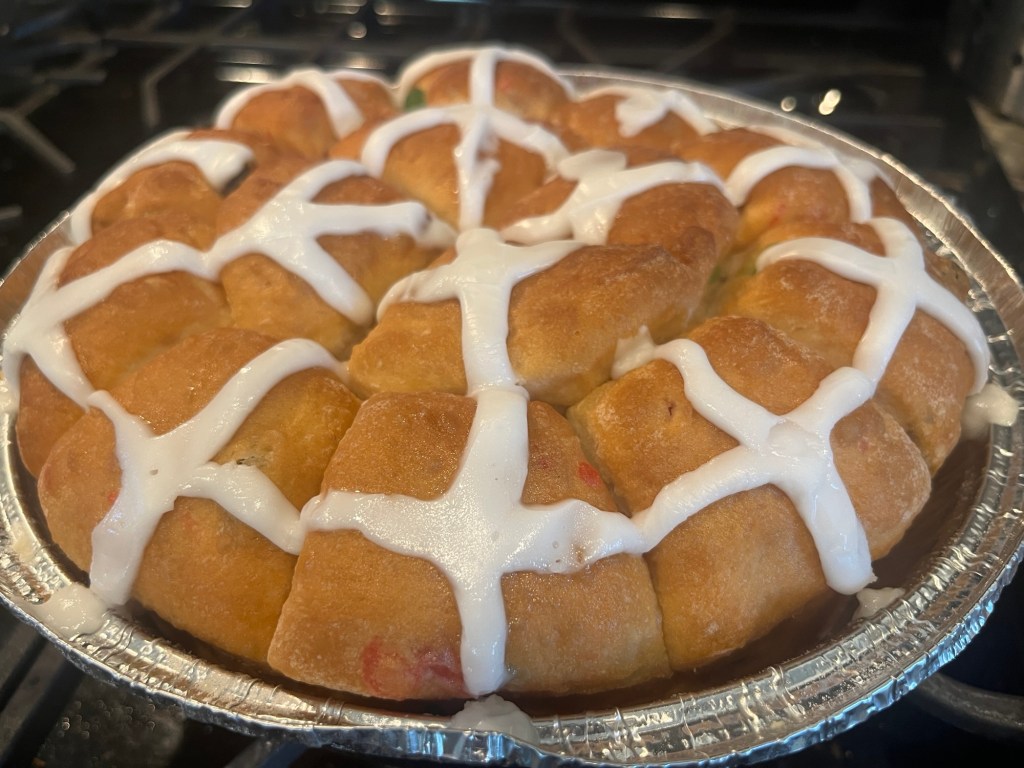
I had never seen or heard of a “Hot Cross Bun” – spiced buns with mixed fruit and topped with an icing cross – until my travels and research took me to Bermuda 🇧🇲 . One bit of folklore attributes these to have originated in 16th/17th England, due to a ban on the sale of spiced baked goods during Easter and Christmas. Apparently a resourceful baker decided if such buns were “blessed” with a cross it would get around such prohibitions by making their sale one with a religious connotation.

Whatever the origins though, generally after Lent all I have on my mind is the taste of these spicy, fruity, and sweet delectable treats. And in recent years, I am thankful they have made their way to the States.

Today, I was fortunate to find a pan of fresh Hot Cross Buns at Yummaries Bakery in Smithfield.

Which brings me to another bit of history.

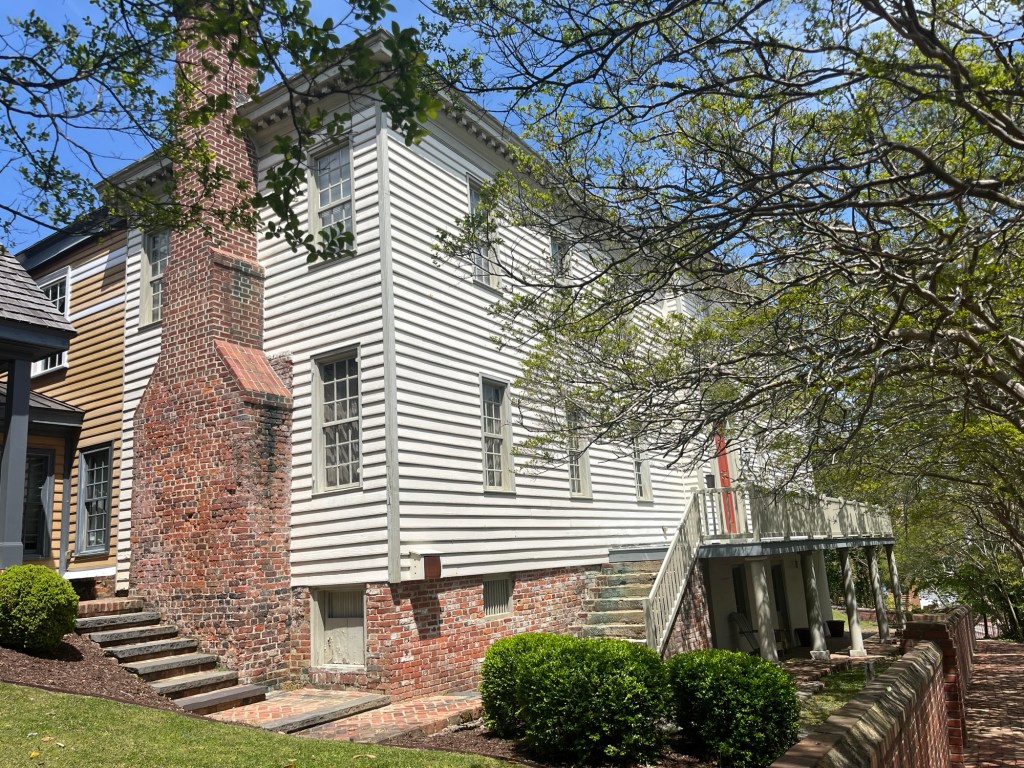
The Town of Smithfield also has multiple Bermuda connections. Those who know a little something of Smithfield history will recognize the name Captain Mallory Todd and the stately “Todd House” (aka Nicholas Parker house, built in 1750s) located on Main Street.

Captain Mallory Todd, 1742-1817

Mallory Todd, a noted seaman and merchant, was in fact a native of Bermuda and is believed to have come to Smithfield in the 1760s (likely joining another branch of his family, also Bermudian – the Mallorys) to pursue a variety of financial opportunities in the colonies. In the midst of the Revolutionary War, Todd expanded his business, and is credited as being the father of our famed “Smithfield ham” – curing them so that they would be preserved during their export across the Atlantic to England, Bermuda, the Caribbean, and abroad.

So today, while I enjoy my hot cross buns and reflect on the solemnity of Good Friday, I am also mindful of the great irony that these same Smithfield-made cross buns were likely being enjoyed by the Mallory and Todd families some 250+ years ago as well.

And that little idea of Captain Todd’s – curing and shipping local hams 🐖 – well it seemed to take off pretty well, too!
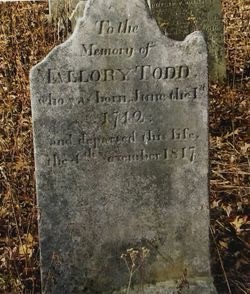
Gravestone of Captain Todd, Wrenn’s Cemetery, Isle of Wight County, Virginia

The Parker/Todd House, along Main Street, Smithfield, Virginia
The 250th Anniversary of South Quay Baptist Church

Memorial table and portrait of South Quay’s longest-serving minister, Rev. James E. Jones.

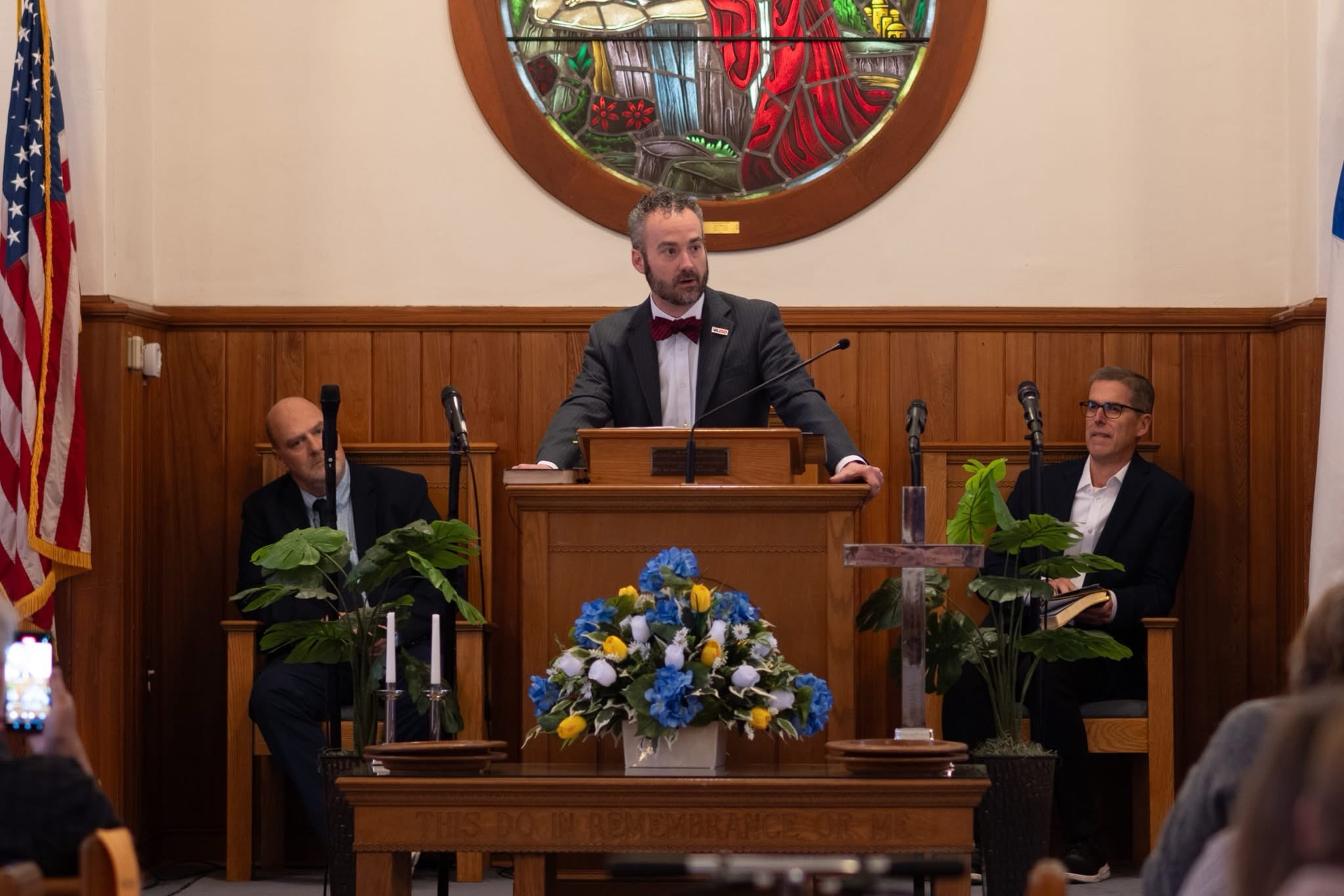
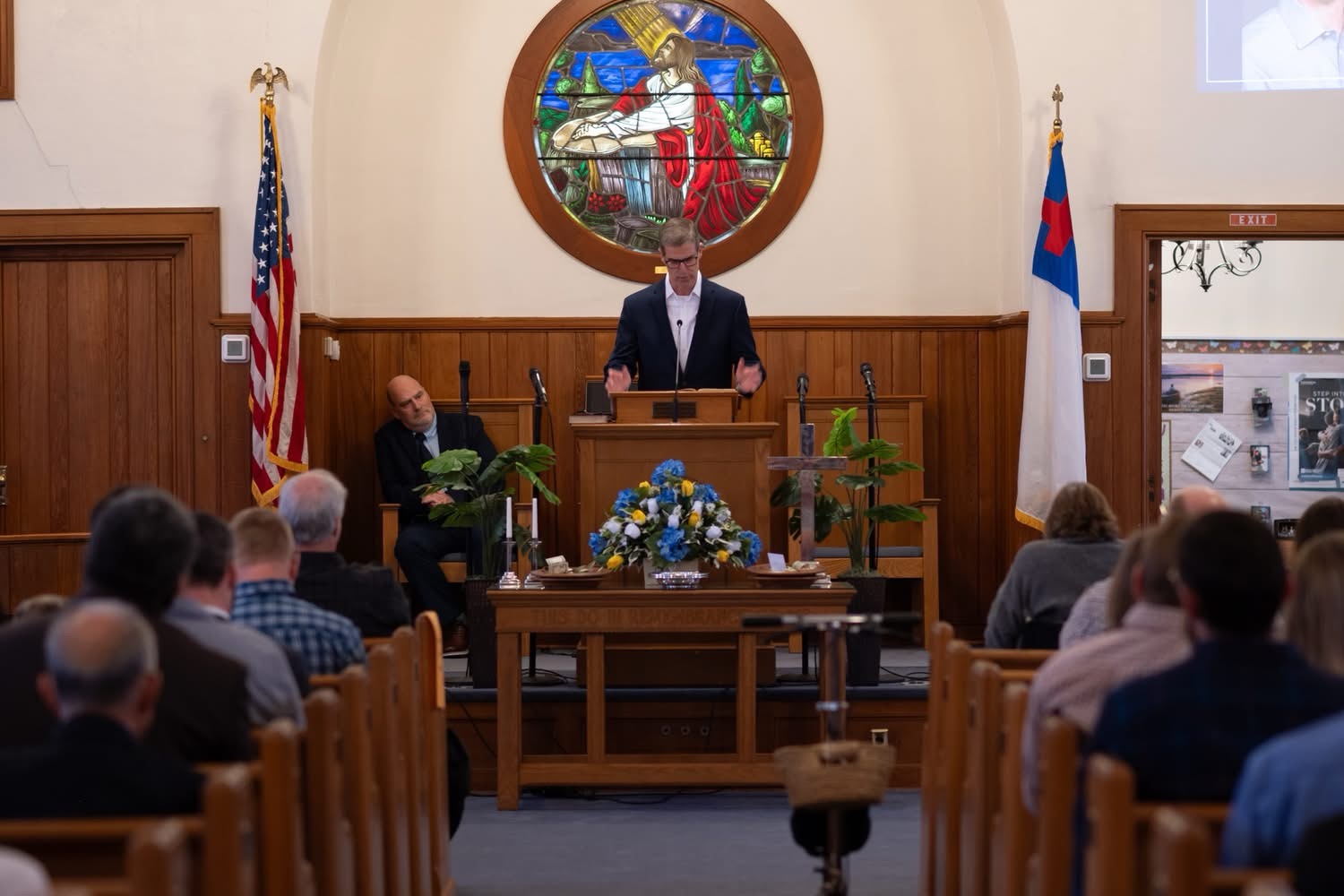
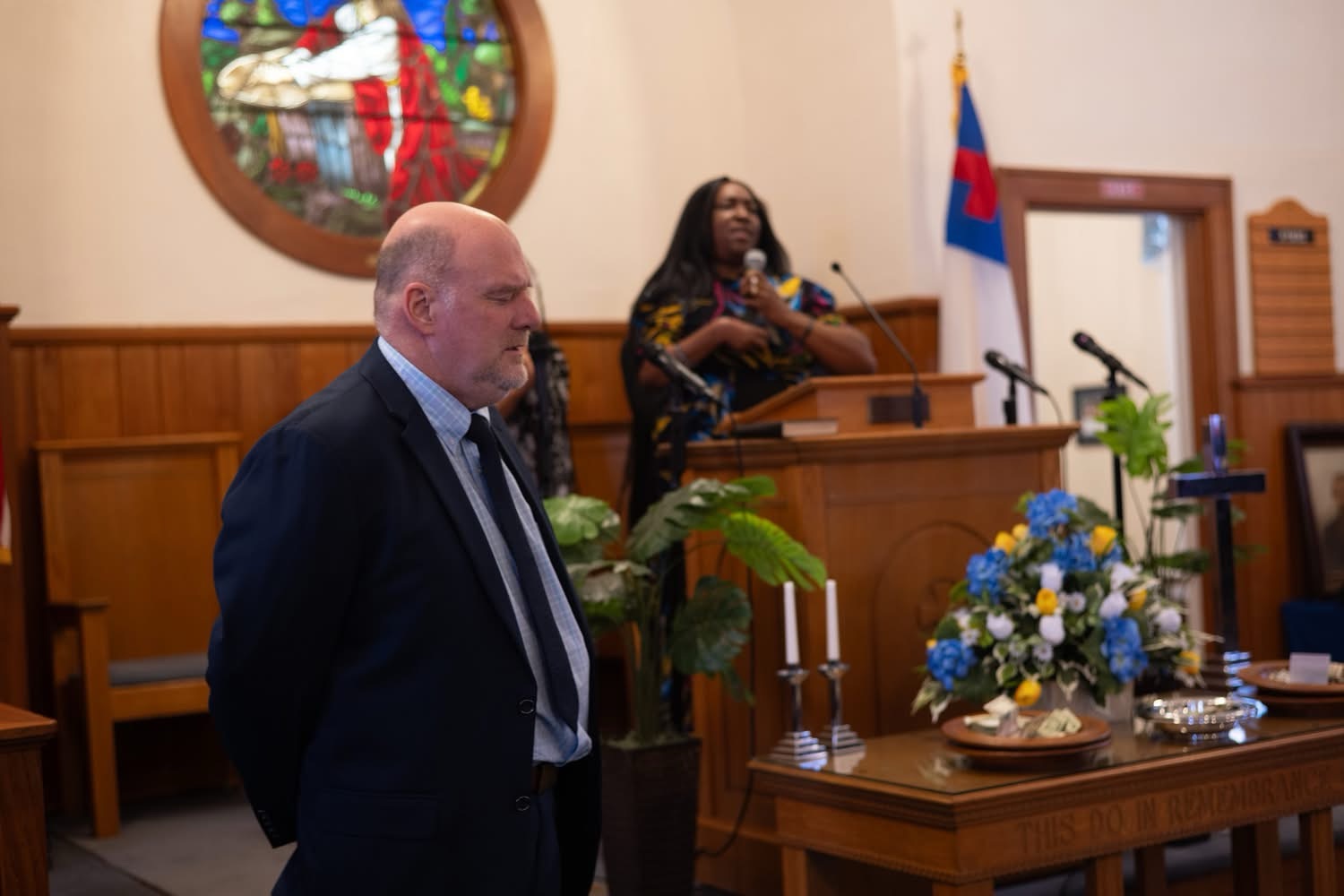
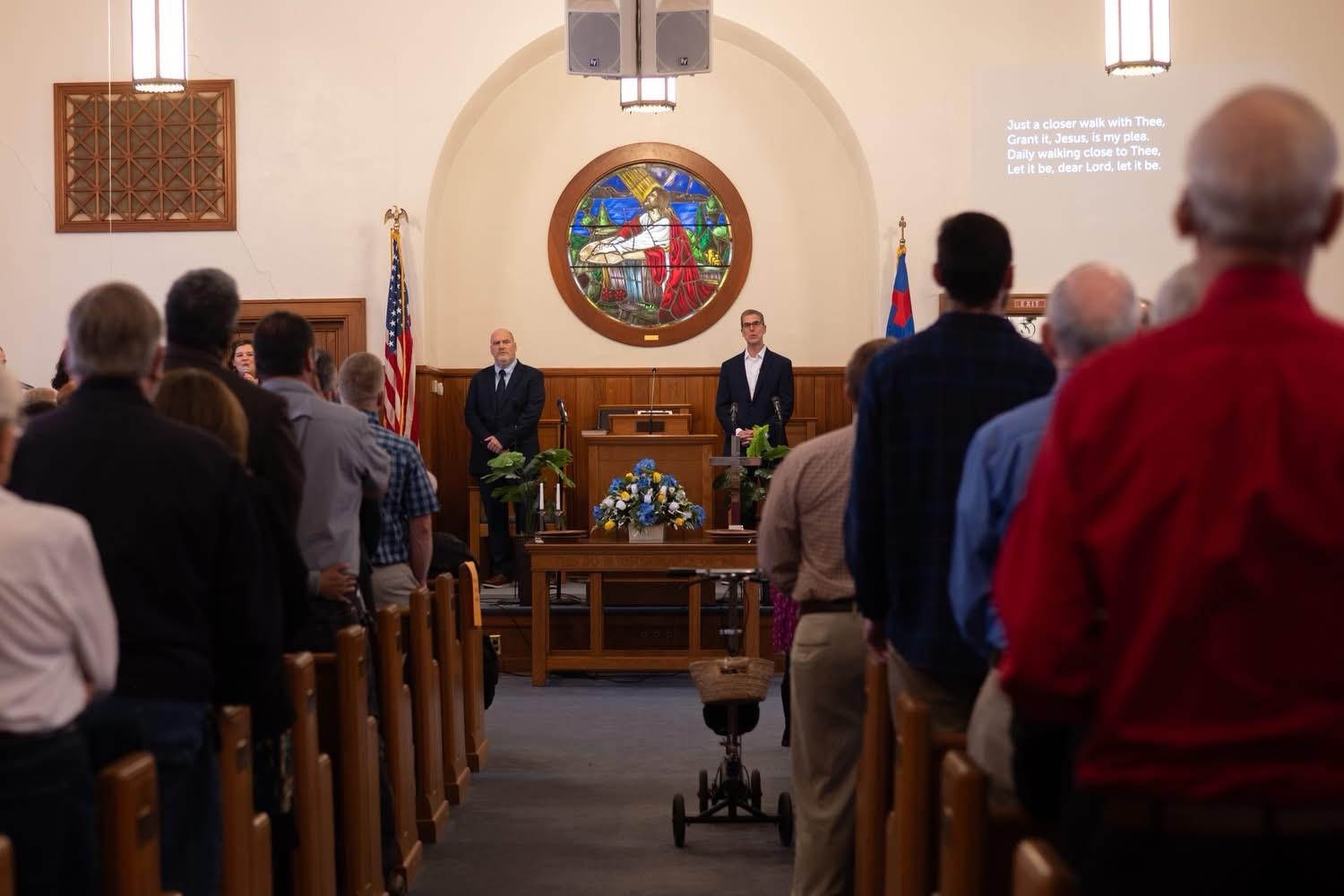
I had the distinct privilege of speaking at the homecoming celebration held on Sunday, March 16, recognizing South Quay Baptist Church for its 250th anniversary. It was a packed-house, with standing room only and just a wonderful day of sharing history, fellowship, and worship!

The pictures below are courtesy of South Quay’s Facebook page.

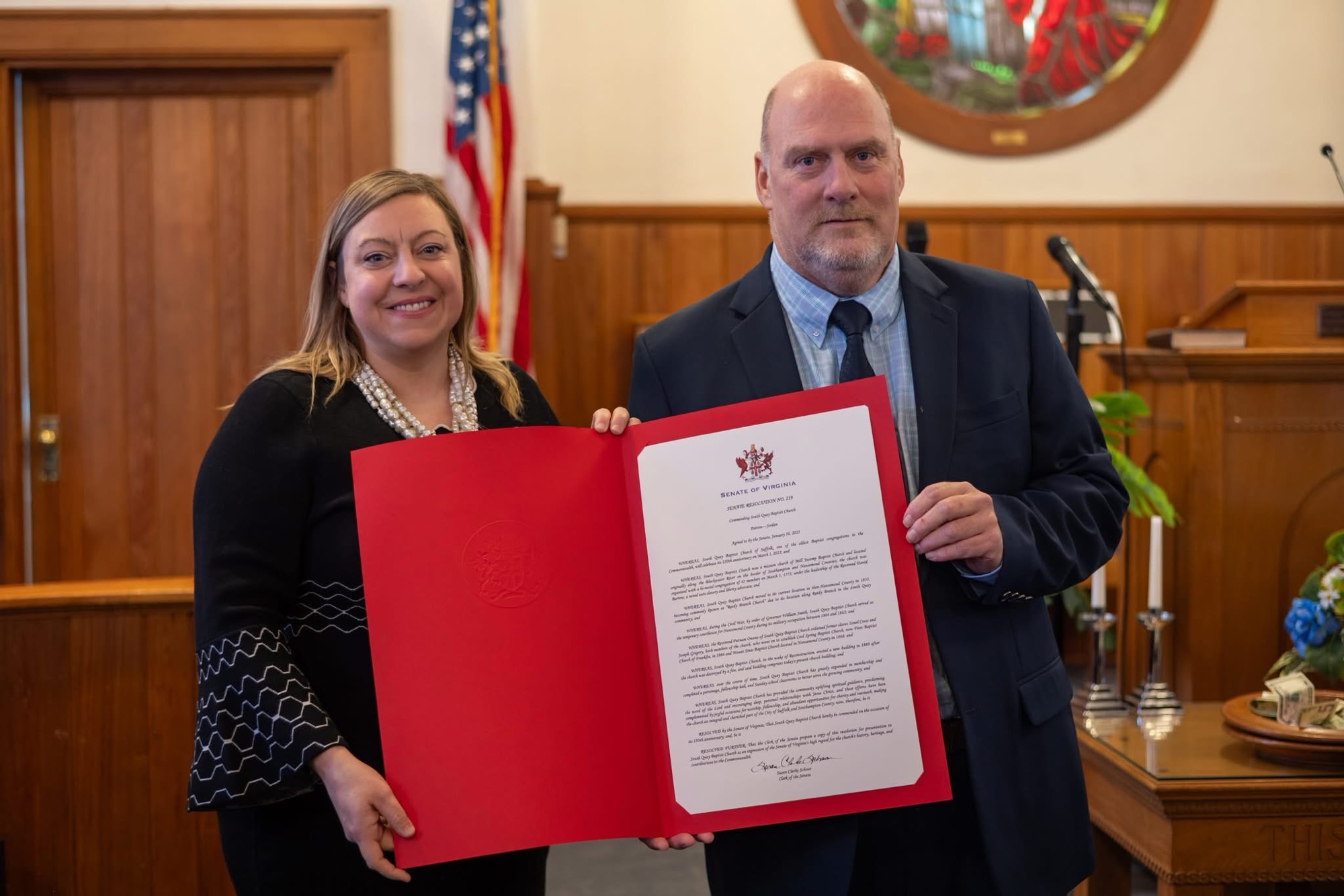
Additionally, the following resolution was passed by the Senate of Virginia as SR219 commending South Quay on this great honour and outlining the Church’s history:

SENATE RESOLUTION NO. 219

Offered January 23, 2025

Commending South Quay Baptist Church.

—————

Patron—Jordan

—————

WHEREAS, South Quay Baptist Church of Suffolk, one of the oldest Baptist congregations in the Commonwealth, will celebrate its 250th anniversary on March 1, 2025; and

WHEREAS, South Quay Baptist Church was a mission church of Mill Swamp Baptist Church and located originally along the Blackwater River on the border of Southampton and Nansemond Counties; the church was organized with a bi-racial congregation of 42 members on March 1, 1775, under the leadership of the Reverend David Barrow, a noted anti-slavery and liberty advocate; and

WHEREAS, South Quay Baptist Church moved to its current location in then-Nansemond County in 1835, becoming commonly known as “Reedy Branch Church” due to its location along Reedy Branch in the South Quay community; and

WHEREAS, during the Civil War, by order of Governor William Smith, South Quay Baptist Church served as the temporary courthouse for Nansemond County during its military occupation between 1864 and 1865; and

WHEREAS, the Reverend Putnam Owens of South Quay Baptist Church ordained former slaves Israel Cross and Joseph Gregory, both members of the church, who went on to establish Cool Spring Baptist Church, now First Baptist Church of Franklin, in 1866 and Mount Sinai Baptist Church located in Nansemond County in 1868; and

WHEREAS, South Quay Baptist Church, in the wake of Reconstruction, erected a new building in 1889 after the church was destroyed by a fire, and said building comprises today’s present church building; and

WHEREAS, over the course of time, South Quay Baptist Church has greatly expanded in membership and completed a parsonage, fellowship hall, and Sunday school classrooms to better serve the growing community; and

WHEREAS, South Quay Baptist Church has provided the community uplifting spiritual guidance, proclaiming the word of the Lord and encouraging deep, personal relationships with Jesus Christ, and these efforts have been complemented by joyful occasions for worship, fellowship, and abundant opportunities for charity and outreach, making the church an integral and cherished part of the City of Suffolk and Southampton County; now, therefore, be it

RESOLVED by the Senate of Virginia, That South Quay Baptist Church hereby be commended on the occasion of its 250th anniversary; and, be it

RESOLVED FURTHER, That the Clerk of the Senate prepare a copy of this resolution for presentation to South Quay Baptist Church as an expression of the Senate of Virginia’s high regard for the church’s history, heritage, and contributions to the Commonwealth.

Running the blockade…

A couple of new additions to my “crew” of blockade runner images.

George Washington Davis of North Carolina (1832 – circa 1900)

G.W. Davis was born into a seafaring family near Shackleford banks, Carteret County, North Carolina, in 1832. Little is known of his early life until he appears as the 2nd Mate of the iron-hulled paddle steamer, Britannia, which had been launched from Scotland in the spring of 1862. The Britannia made six runs through the blockade before being captured off of the Bahamas on June 22, 1863, by the USS Santiago de Cuba. Davis, along with many of his fellow crew members, were sent to Fort Lafayette, NY; and later transferred to Fort Warren, Boston, Massachusetts, in September of 1863. Davis remained imprisoned at Fort Warren for the remainder of the War and after, until June 20, 1865.

This CDV of G.W. Davis was taken by photographer J.W. Black, Boston, Massachusetts, during his imprisonment at Fort Warren. Black also appears in several of the group images of Fort Warren prisoners that have been published.

After the War, Davis settled in Smithville (now Southport), North Carolina, where he married, raised a family, and continued in maritime pursuits as a sailor and pilot. He died prior to 1900.

George E. Lyell of Virginia (1837 – 1868)

A native of Norfolk, Virginia, George E. Lyell had been a member of the 54th Virginia Militia before he enlisted as a Private in Captain Nathan W. Small’s Signal Corps Company on March 5, 1862. This Company ultimately became a part of Major James F. Milligan’s Independent Signal Corps, operating as scouts and signal officers along the James and Appomattox rivers. Lyell was present with his company, and primarily stationed in Petersburg, until detailed in 1864 for signal duty to Wilmington, North Carolina, where he would serve on ships intended to run the blockade. Although the particulars of this service are unknown, he does appear on a list of Confederates in Havana, Cuba, in April of 1865, and later back in the Confederacy, where he was paroled at Charlotte, North Carolina, on May 4, 1865.

After the War, Lyell operated a restaurant and saloon in Norfolk, until an untimely death on July 23, 1868.

The CDV of George E. Lyell was photographed by A. Hobday & Co., Norfolk, Virginia, circa 1866-1868.

(These images are in the collection of and are courtesy of Fred D. Taylor.)

Women’s History Month – March 2025

Since returning from some travels this week, I have had history “on the brain,” and I have simply wanted to research and write. So with this month honoring women, a recent addition to my “caretaking family” was immediately on my mind. Here’s the rest of the story…

When it comes to collecting old photographs, finding one that is identified is usually about a fifty-fifty shot (maybe less?) It seems to become even more difficult the older the image may be. When a photograph appears that checks the boxes for time period, identification, location, and even more, you have truly been fortunate.

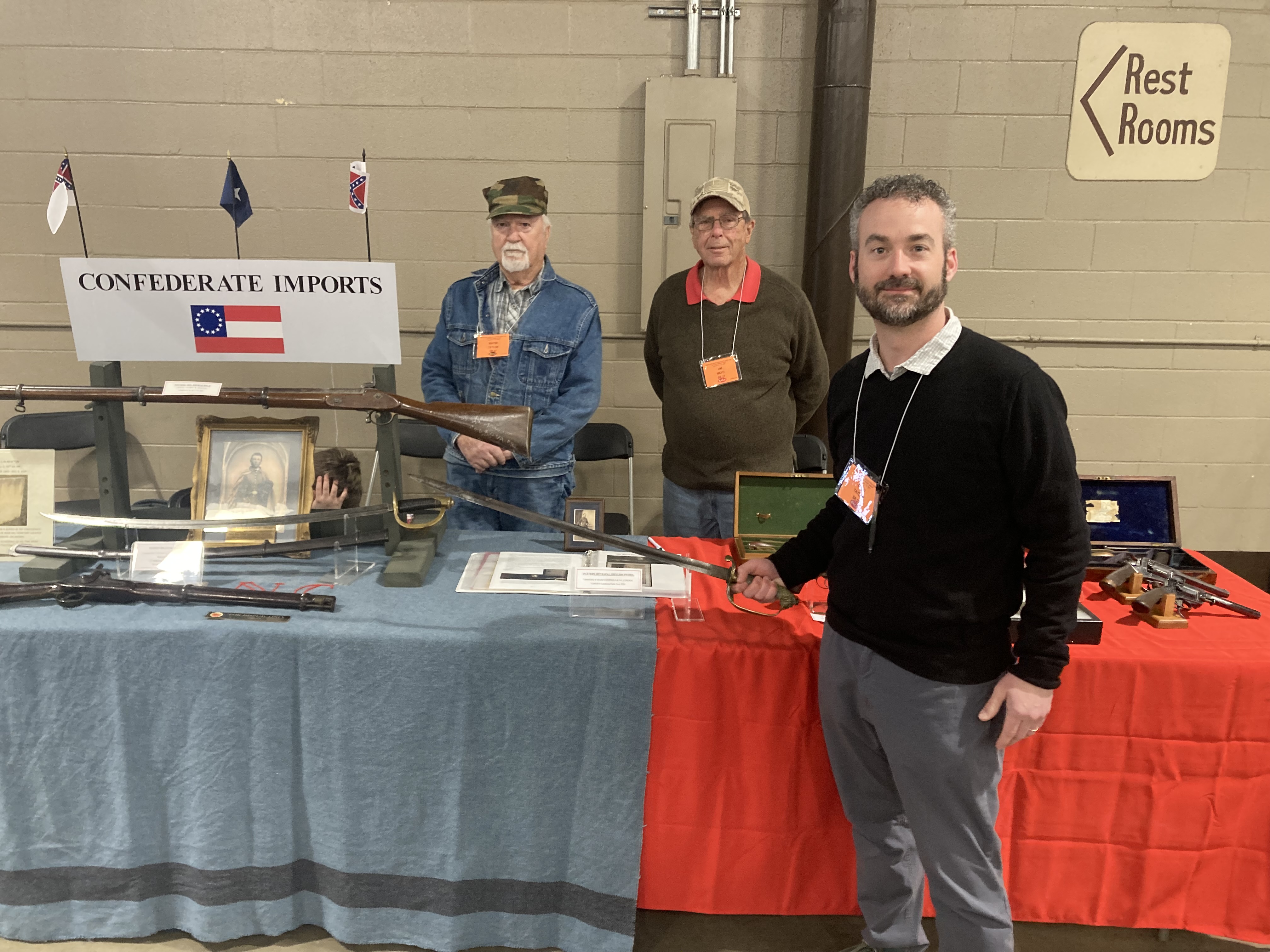
I first saw this daguerreotype a few months back. Candidly, her beauty is what initially struck me. Followed by the photographer’s artistry. I wanted to know more. It had come up for sale from an image dealer, but I missed the purchase by literal minutes to another. Opportunity came to me once again though, and whether serendipity or pure luck, I was able to acquire it – thanks to my friend Ben Rollins.

But the story of this image went much deeper. It was inscribed. It was identified. It had provided a location. It had a date. It was my unicorn.

Meet Eliza V. Taylor. Yes, Taylor.

Daguerreotype of Eliza V. Taylor

Eliza was born in 1830 near Oxford, in Granville County, North Carolina, the oldest child of John Camillus Taylor (1800-1873) and his wife Emily Elizabeth Tillinghast (1807-1841). Without a doubt, Eliza was born into a family of privilege. Her father, John C. Taylor, boasted lineage from the prominent colonial Taylor family that produced two Presidents and a signer of the Declaration of Independence; he was a graduate of the University of North Carolina, a prominent merchant, farmer, educator, active in the Whig party and as such, a member of the state legislature in both the House and Senate. Her mother, Emily Tillinghast, was similarly well-situated, being descended from a noted Rhode Island family. Tragically, she passed away when Eliza was just eleven years old, herself at the young age of 34. John C. Taylor remarried though, and Eliza was raised predominantly by her step-mother throughout her teenage years.

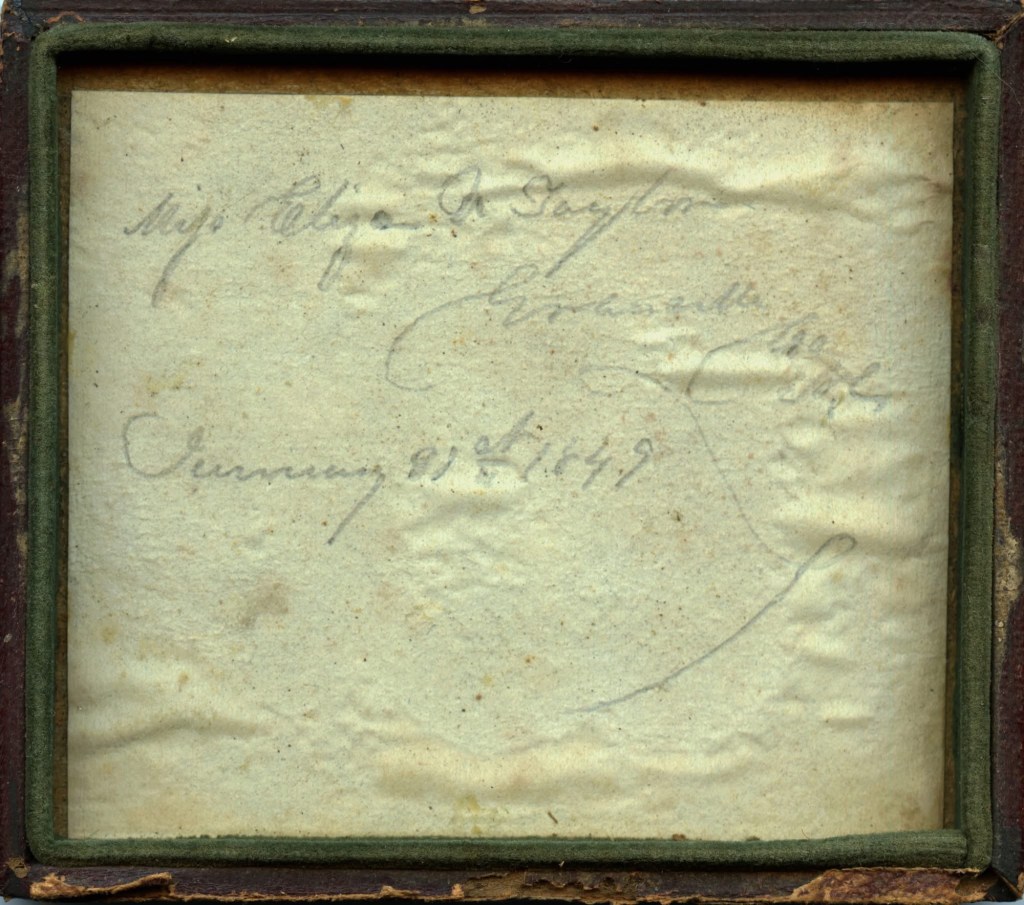
Along with her siblings, Eliza was given the foremost education and cultural opportunities. When her father served in the legislature or was otherwise on business travel, she would frequently accompany him to the capital at Raleigh. It was likely during one of these trips to the “big city” that this photograph was taken, and is possibly the work of daguerrean artist John C. Palmer. The image is dated January 31, 1849, when Eliza was 18 years old.

Inscription inside of image case.

Unfortunately, this story ends on a sad note just a few years later. Eliza passed away on April 3, 1852, from what was described as a “protracted illness.” Though in the prime of her life and taken at the young age of 22, I hope this brief tribute will help to carry on her memory and story. In so doing, I conclude with the following. Eliza (and her family) were active members of St. John’s Episcopal Church in Williamsboro, now in Vance County. It was the Rector of that Parish who penned her obituary. He described Eliza as:

“…dedicated in faith to God” from an early age, and “as a daughter, she was all that parents could ask, affectionate, tractable, cheerful, and ever ready to ‘do what she could’ for the happiness of all around her; as an elder sister her example was most salutary; as a friend she was constant and sincere. Admired and beloved she nevertheless preserved the simplicity, candor and guilelessness of her character unimpaired, she was kind and tender-hearted, yet firm, cheerful and buoyant in spirit, yet innocent and discreet; she had ever an ear for the tale of woe, a tear for scenes of distress, a heart to respond to the call of want… she had among those of her own youth, few peers, and no superiors.”

One could not have ever asked to have fulfilled such a complete life.

Celebrating the Return of General Lafayette

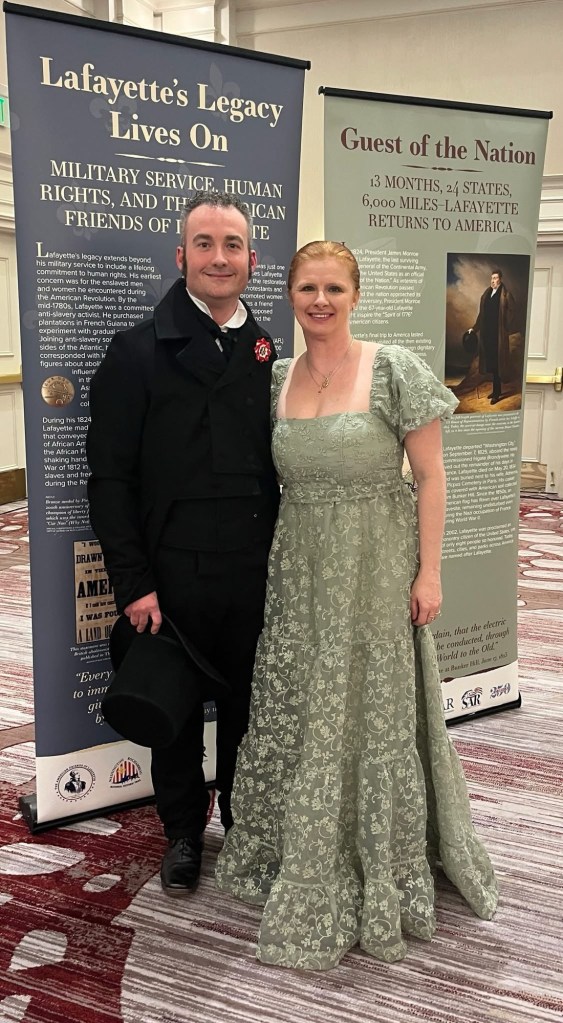
Today, I am still reveling in the excitement of the at-capacity, 250+ person banquet commemorating the February 25, 1825, visit of General Lafayette to Suffolk.

Packed house at the Hilton Garden Inn

We were blessed to have the General himself – portrayed by the talented Mark Schneider, and numerous dignitaries locally and abroad, the Mayor and members of City Council, French military personnel, Virginia American Revolution 250, scholars of the The American Friends of Lafayette, Daughters of the American Revolution, and so many more!
“The General” addresses the crowd.

Of course, it would take such a significant event to cause me to abandon my beard of years, in order to channel my inner 1820s gentleman! Not the least of which was the high honour of serving as the Master of Ceremonies for a wonderful evening of history, and the celebration of our timeless bond with France.

Viva la France & General Lafayette!

A Life Well Lived

Nicholas Lusher, 1962-2024

It seems like these last few weeks have been filled with nothing but news of illness and loss; and again this morning I woke up to learn of the passing of another friend.

I was first introduced to Nicholas Lusher back in 2018, as I began my journey into the early history of photography in Bermuda. To say he was an expert – and I do not toss that word around lightly – was an understatement, having an academic, professional, and personal/family background that did in fact make him what his obituary referred to as an “internationally esteemed art and antiques dealer dedicated to preserving the island’s cultural heritage.” But he was so much more than the acclaimed Caribbean and New York art dealer on the surface.

Upon learning of my interests, Nicky welcomed me into his world immediately, excited to provide research material, make referrals, and open doors that I otherwise would never have had as an outsider to Bermuda. We collaborated for several years thereafter as collectors, historians, and ultimately as friends. Once I published my story on photographer Samuel W. Gault (which I naively thought would be the end of my research), we remained in contact to share new historical findings and “talk shop.” And despite the fact he was in the business to find and sell art, he would frequently tip me off when Gault images would pop up in the marketplace, giving me the first chance on them.

I will forever be grateful for Nicky’s mentorship and the legacy he leaves in the art world, but most of all I send my deepest condolences to his family, of which I know he so loved and cherished even more. Requiescat in pace, my friend.

Veterans Day, 2024

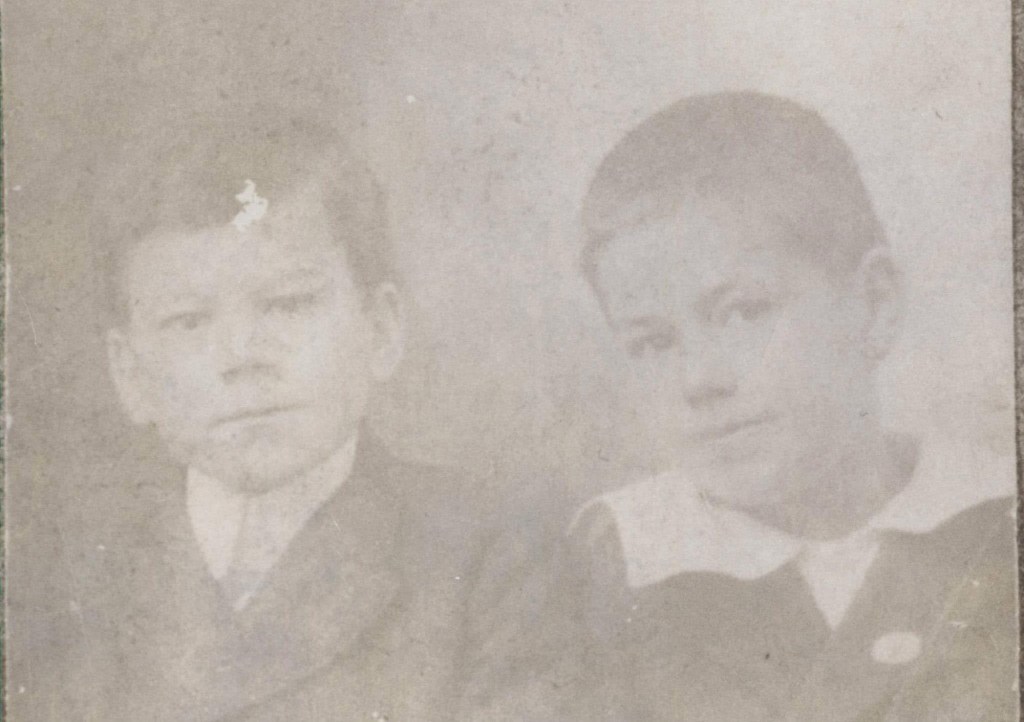
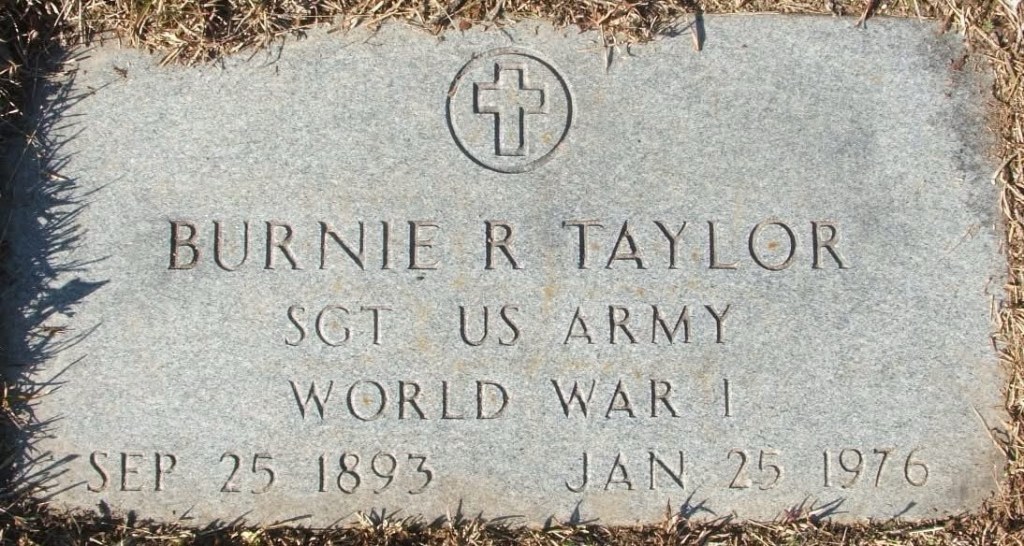
Among many others who I thank for their service today, I remember my grand-uncle, Burnie Robert Taylor (pictured here as a young man, on the right.)

Charles Hobson Taylor and Burnie Robert Taylor as boys, circa 1903.

Uncle Burnie was born in Brunswick County, Virginia, in 1893, but raised primarily just across the state line in Roanoke Rapids, North Carolina. He enlisted at the age of 22 in Company F of the 3rd North Carolina Infantry (National Guard) on June 26, 1916, prior to the American entry into World War I, and spent his early training in El Paso, Texas, as a part of General Pershing’s expedition against Pancho Villa.

His unit was drafted and federalized in August 1917, becoming the 120th Infantry, a part of the 30th Division, under the Command of British General Henry Rawlinson during much of the War. Uncle Bernie rose to the rank of Sergeant, and during what was known as the Hundred Days Offensive, was wounded in action on October 9, 1918. According to the family history, he was was felled by machine gun fire to his left hip, and lay on the field wounded for close to a day somewhere near Cambrai, France. He was eventually rescued, and spent the coming months at the Red Cross Military Hospital (No. 21) at Paignton, Devon, England. In December 1918, Uncle Burnie was transported to Liverpool, enroute back to the United States. He arrived in January 1919, and was discharged from Camp Lee, Virginia.

After the War, he returned home to Roanoke Rapids, North Carolina, where he worked the rest of his life as a textile mill worker. He was married to Fannie Eula Collier, and he passed away on January 23, 1976.

Haunted History

Edgar Allan Poe

Tired of just another haunted hay ride or spooky house?

Join us at Suffolk’s oldest house museum – Riddick’s Folly – for an evening of history and readings of the famed macabre writer, Edgar Allen Poe.

The evening will begin with a social period with light hors d’oeuvres from 6:00 – 6:30 PM, followed by the program at 6:35 PM.

This event is free and open to the public, but due to limited seating, please RSVP to riddicksfolly@verizon.net or call 757-934-0822.