With rain set in from the remnants of Hurricane Isaias, I’ve been thinking about how people watched the weather long before radar maps on our phones. We’ve been fortunate locally this hurricane season, but it’s a good occasion to explore an old tradition.
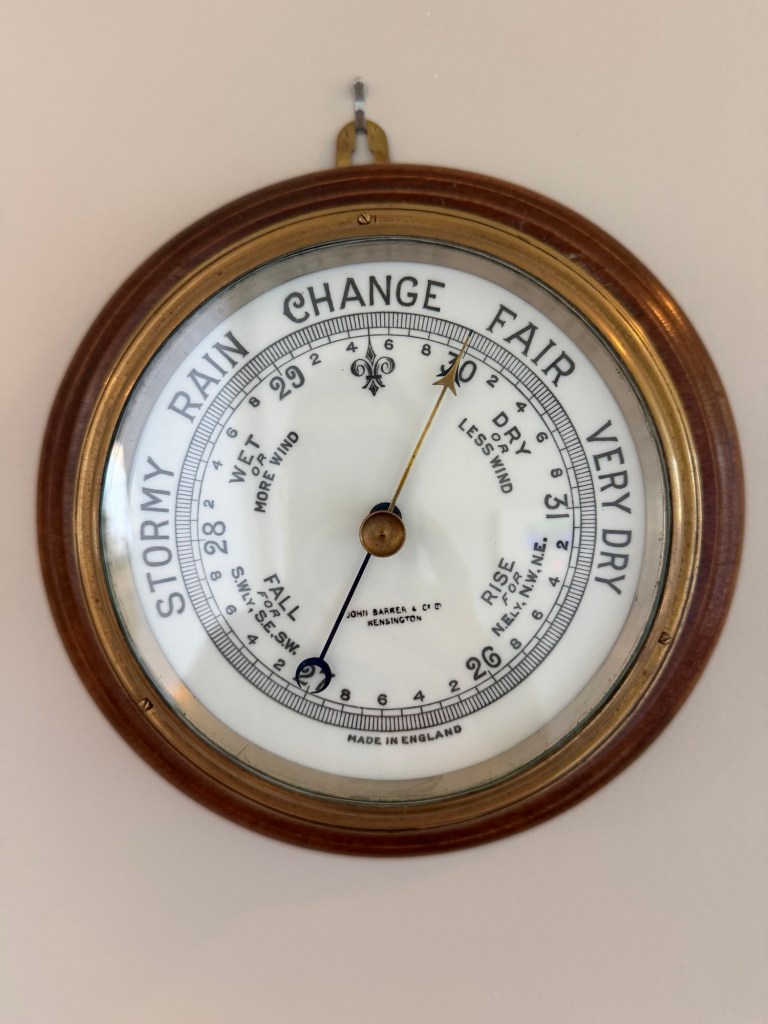
On an early trip to Bermuda, I discovered a unique weather gauge: shark oil. It took five more trips to obtain my own instrument, and this one has a story to tell!
For over 300 years, Bermudians have hung bottles of shark liver oil outside their homes as weather indicators. Tradition holds that clear oil means fair weather; cloudiness, a milky appearance, or stirring sediment warns of unsettled conditions. On an island shaped by seafaring, those clues mattered.
But just any shark oil wouldn’t do. The custom calls for liver oil from juvenile, or “cub,” sharks. A 1982 account in The Bermudian described using small sharks caught between June and September, when their livers were plump, pale, and rich in oil. Fishermen also followed particular phases of the moon for the harvest.
Does it work? In 2015, scientists at the Bermuda Institute of Ocean Sciences found that warming the oil made it clearer, while cooling made it cloudier. Pressure changes alone produced no definitive response. Its changing appearance was real, but its reliability as a storm predictor remained unresolved. At least according to the “experts.”
Conventional barometers work differently. The mercury barometer emerged in seventeenth-century Italy, measuring atmospheric pressure with a column of mercury. Later came the aneroid barometer, whose sealed chamber responds to pressure changes.
Falling pressure often signals unsettled weather; rising pressure generally suggests improvement. Watching the change over time helps tell the story.
What appeals to me about these traditions and devices is the habit behind them: paying attention. Watching the sky, studying the sea, and remembering what happened the last time things looked this way.
This weekend, I’ll be watching my little piece of Bermuda history and recording my findings. In the meanttime, what old sayings or traditions did your family pass down about the weather?
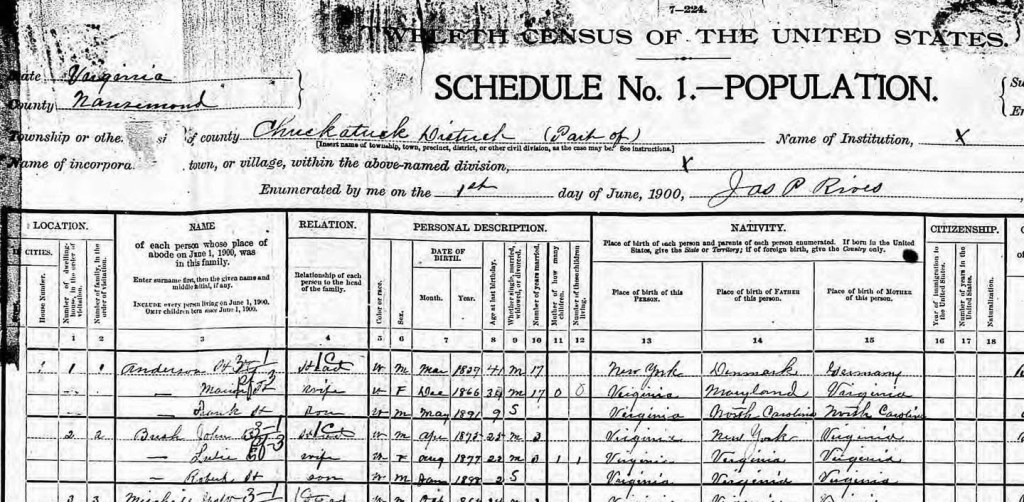
October is also known for Family History Month, a wonderful opportunity to discover the people, places, and experiences that helped shape our families — and, in many ways, ourselves.
My own journey into genealogy began more decades ago with a fourth-grade history project at Driver Elementary School. What started as a simple school assignment sparked a curiosity that never went away. Little did I know that project would lead to a lifelong passion for genealogy, historical research, and discovering the stories of those who came before us.
Of course, researching family history looked quite different back then!
Long before Ancestry.com and digitized records, genealogy meant spending hours in libraries and courthouse record rooms, turning the pages of old deed books, examining handwritten records, and scrolling through seemingly endless reels of microfilm. Sometimes an entire afternoon of research might produce only one new name, date, or connection. But when you finally found that missing piece of the puzzle, it was worth every minute.
Today, exploring your family tree is easier than ever. Online resources such as Ancestry.com and Newspapers.com put millions of historical records and newspaper pages at our fingertips. DNA testing has opened entirely new avenues of discovery, sometimes connecting relatives who never knew one another existed.
But the real reward of genealogy isn’t simply collecting names and dates. It’s discovering the people behind them.
Who were your great-grandparents? Where did they live? How did they make their living? What brought them to the community you now call home? What hardships did they endure, what accomplishments did they celebrate, and what traditions did they pass along?
Here in Suffolk, old Nansemond County, and Isle of Wight, our family histories are woven into the larger story of Tidewater Virginia. The history of our churches, farms, villages, businesses, and communities is, in many respects, the collective history of the families who built and sustained them.
And sometimes, the most valuable historical records aren’t found in a courthouse or online database. They’re tucked away in an old family Bible, written on the back of a faded photograph, preserved in a bundle of letters, or carried in the memories of a parent or grandparent.
That brings me to something I believe is especially important: Family history isn’t just about discovering the past. It’s about preserving it for the future.
How many old photographs have we encountered with no names written on the back? How many wonderful family stories have been lost because nobody thought to write them down?
One of the greatest tragedies in family history isn’t what we never discover. It’s what one generation knew, but never passed along to the next.
You don’t have to be an expert genealogist to make a difference. Start with what you know. Ask questions of your parents, grandparents, aunts, and uncles. Look through that old box of photographs. Record a family story. Visit a cemetery. Follow a clue and see where it leads.
You may uncover a surprising connection, discover an ancestor whose life inspires you, or simply gain a deeper appreciation for the ordinary people whose lives and sacrifices made your own possible.
And remember, someday you will be part of someone else’s family history. What stories will you leave behind?
This Family History Month, I encourage you to do more than explore your roots. Take the time to preserve a little of your family’s story for the generations yet to come.
Because every family has a history worth remembering.
So share your stories in the comments. You never know when your discovery might inspire someone else to begin their own journey!
🤍 So… are we wearing white after Labor Day or not?
Labor Day has come, and for those of us raised in the South, that brings up one of life’s great etiquette questions:
Can you still wear white?
Southern Living recently tackled the subject, and while modern fashion says absolutely yes, old Southern habits can be mighty hard to shake.
The tradition of packing away the white after Labor Day goes back generations. White linen, dresses, suits, and shoes were practical choices for hot summer weather and became closely associated with summertime and vacation. As fall arrived, wardrobes traditionally shifted toward darker colors and heavier fabrics — and Labor Day eventually became the unofficial line in the sand.
But somewhere along the way, a practical seasonal change became a rule.
And in the South, we took that rule seriously. 😂
For many of us, “no white after Labor Day” was less about high fashion and more about what Mama and Grandmama taught us. You put away the white shoes, brought out the darker colors, and didn’t question it.
Today, fashion experts generally agree that white works year-round. Cream, ivory, winter white — and, yes, even those white jeans — can all have a place in a fall wardrobe.
Still, traditions have a funny way of sticking with us.
So while my head may say wear the white, there’s a little Southern voice somewhere in the back of my mind asking:
“After Labor Day, though?” 😳😂
How about y’all? Are you Team Wear the White or Team Put It Away Until Easter?
Today we turn the calendar to September, and along with the return to school, football, and the hope that fall may eventually find its way to Virginia, September also happens to be National Bourbon Month.
Now, around The Chuckatuck Life, we don’t need much encouragement to appreciate a good bourbon — but there is actually a little history behind the glass.
We generally think of bourbon as synonymous with Kentucky, and rightly so. But there is an interesting Virginia footnote to that story:
Kentucky was Virginia.
Following the American Revolution, settlers pushed westward into what was then Virginia’s “Kentucky country,” taking with them the tradition of turning surplus grain into whiskey. Kentucky would not become a separate state until 1792. So perhaps Virginia can claim at least a seat at the table whenever the history of America’s native spirit is being discussed.
And if you want to turn National Bourbon Month into an excuse for a day trop, put A. Smith Bowman Distillery in Fredericksburg on the list.
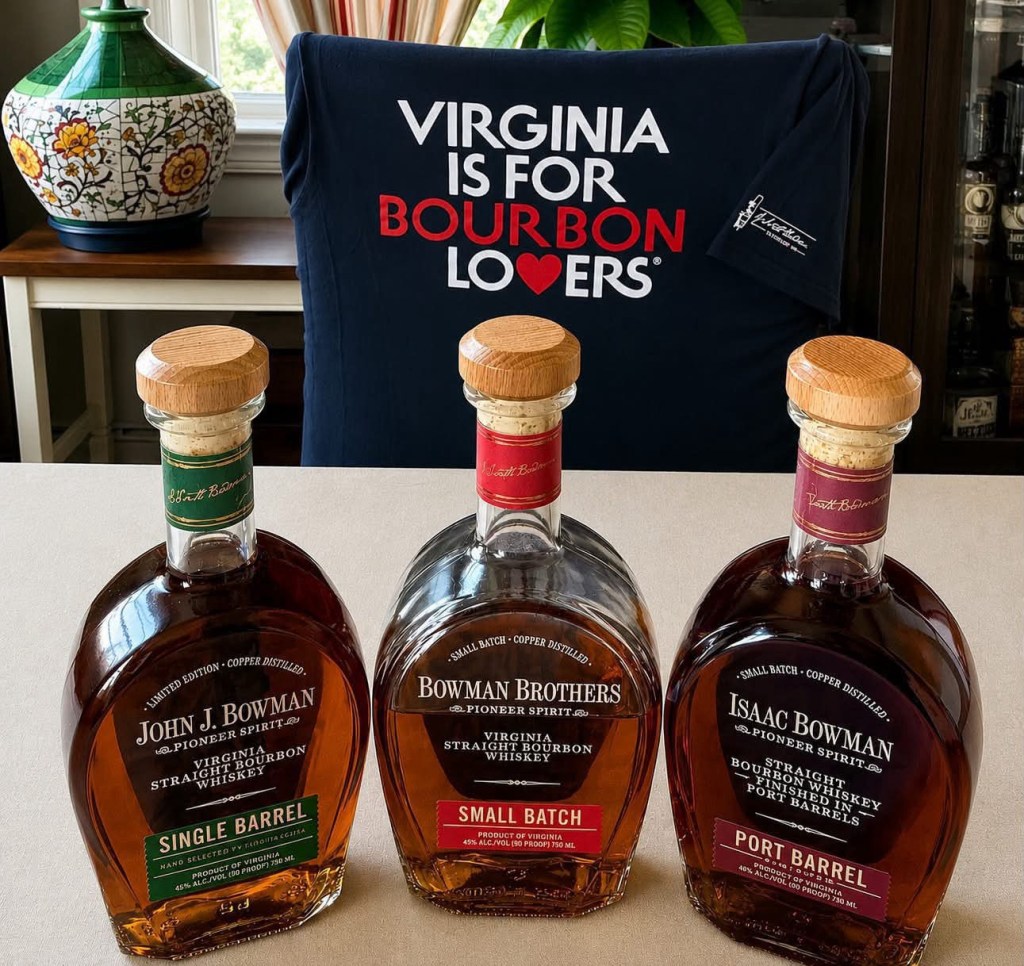
Bowman’s story began after Prohibition. In 1927, Abram Smith Bowman purchased a 7,200-acre farm in Fairfax County. With an abundance of grain being produced there, the family entered the whiskey business, establishing the distillery in 1934. The operation later moved to Fredericksburg, where Bowman (now owned by Sazerac) continues the tradition today.
There’s also an interesting Kentucky-Virginia partnership inside the bottle. The Bowman recipe is believed to use a mix of the Buffalo Trace #1 and #2 mash bills. The exact proportions are proprietary, but the whiskey receives its initial distillation in Kentucky before coming to Fredericksburg, where Bowman distills it again and then puts it into new charred oak barrels to mature in Virginia for 8-10 years.
My personal recommendation is the award-winning John J. Bowman Single Barrel.. At 100 proof, it has enough strength and character to be interesting without becoming overpowering, and each bottle comes from a single selected barrel rather than a blend. After first getting that “Virginia hug,” a proper taste will give you notes of toffee, leather, figs and almonds.
Best of all for fellow Virginians, you don’t necessarily have to make the drive to Fredericksburg to find a bottle: Bowman Single Barrel is carried by Virginia ABC, although inventory naturally varies by store.
Still, I recommend the field trip.
The Fredericksburg distillery gives you the opportunity to see how that Kentucky-distilled spirit becomes Virginia bourbon — from that additional distillation through barreling, aging and ultimately bottling.
So sometime this September, pour a good bourbon neat, mix an Old Fashioned, or better yet, take the drive to Fredericksburg and learn a little of the history behind the glass.
Because sometimes learning a little history is best done one barrel — or one glass — at a time. Cheers from Chuckatuck. 🥃
And we’re just getting started. Stay tuned throughout National Bourbon Month as we highlight some of our favorite bourbons, share a few favorite recipes and cocktails, and find plenty of good reasons to raise a glass along the way.
So what is your favorite bourbon, and how do you take it?
Some people travel hundreds of miles to experience history. Around Chuckatuck, we only have to look across the creek.
From our home on Cedar Creek, we can look toward Mattanock Town, the ancestral home of the Nansemond Indian Nation. It’s a reminder that long before Suffolk existed — long before Virginia appeared on a map — this land was home to the Nansemond people, whose name means “fishing point.” For thousands of years, they lived along the Nansemond River, fishing its waters, harvesting oysters, hunting its forests, and farming its fertile shores.
English settlement though brought warfare, displacement, and centuries of pressure to abandon their identity. Nevertheless, the Nansemond endured — maintaining their families, their community, and their connection to this land through an unlikely marriage between a 17th century English minister and the daughter of a Nansemond Chief. Today, they remain an important part of our community — not just a chapter in a history book, but our neighbors.
My own appreciation for their story began when I was young. My father shared his fascination with local history after spending his childhood walking freshly plowed fields, finding arrowheads left behind by those who called this place home generations before us. Those small discoveries sparked a lifelong respect for the people who came before us.
One memory has stayed with me for decades: meeting Chief Earl “Running Deer” Bass at a Nansemond Pow Wow. I was just a kid, and he was already in his 80s, but I remember him as a kind, gentle soul – and a man who loved Christ. He was fiercely proud of his Nansemond heritage and of his Christian faith — an example that has stayed with me.
In 1988, the tribe held its first Pow Wow back on their ancestral land, calling it the “Nansemond Indian Homecoming.” This weekend, that history comes alive once again as the 38th Annual Nansemond Indian Pow Wow returns to Mattanock Town. Gates open at 10 a.m. on Saturday and Sunday, with Grand Entry at noon on Saturday and 1 PM on Sunday. Visitors can experience traditional dancing and singing, Native arts and crafts, food, fellowship, and opportunities to learn about one of Virginia’s oldest living cultures. Admission and parking are free, though donations are encouraged to support the tribe’s ongoing work.
If you’ve never been, I encourage you to go. It’s a chance to celebrate a people whose story has never ended, and whose roots remain firmly planted right here in our backyard.
Sometimes the richest history isn’t found in a museum. Sometimes, it’s just across the creek. From our Chuckatuck porch where we can still hear the drumbeats of the Nansemond, until next time, that’s another Fred On History Friday.
This has been a tough week, and leaving me further heartbroken is hearing the passing of my friend, Ben Jones.
To millions of people, Ben was Ben Jones aka “Cooter” from The Dukes of Hazzard—a beloved character whose humor, warmth, and unmistakable voice became part of American popular culture. But to those of us who were fortunate enough to know him personally, Ben was so much more. He was a man of conviction and compassion, a gifted storyteller, a loyal friend, and a genuinely kind and gracious human being.
Ben and I first met in 2001, in what now seems like another lifetime. We became unlikely allies in the world of politics. Ben had served as a Democratic member of Congress and, with his characteristic self-deprecating humor, liked to say that he lost reelection because of an illness: “The voters were sick and tired of me.”
That was Ben. He could find the humor in almost anything, including himself. But beneath the laughter was an intelligent, thoughtful man who cared deeply about his country, his history, his friends, and the causes to which he committed himself.
Although politics first brought us together, we soon discovered that we shared common ground in many other ways. We both had a deep affection for North Carolina and Virginia, as Ben was born in eastern NC, but the railroad brought his family to Tidewater while he was still young. He spent a great deal of time in Suffolk, particularly in Driver, where his grandparents lived.
Ben eventually graduated from Woodrow Wilson High School in Portsmouth, before attending the University of North Carolina, where he studied theatre. From there, of course, his journey carried him into acting, music, television, public service, and a place in the hearts of generations of fans.
When Ben and I met, questions surrounding Southern history and heritage were becoming increasingly contentious in Virginia. From that beginning grew a lasting friendship. Together, we lobbied legislators and governors, gave television and newspaper interviews, attended meetings, and spent more hours than I can count talking about history, politics, people, and life.
At the time, I was making my way through college and then law school, while Ben was managing his Cooter’s establishments in Tennessee and Virginia. Our lives were busy, and often very different, but the friendship endured.
After the political tempests of those years had settled, Ben and I continued to reunite from time to time. We saw one another at memorial services and community events, including Driver Days, where Ben and his band appeared on several occasions. Anyone who saw Ben perform knew that he did not merely entertain an audience—he embraced it. He made people feel that they were part of the show and, for a little while, part of his extended family.
One reunion that remains especially vivid in my memory came when Ben was promoting his autobiography at Prince Books in Norfolk. I had the privilege of introducing him to my father and having him sign one of his books. I also had the opportunity to see Ben in a very different and touching setting, surrounded by many of his former high school classmates who had come to see him.
Here was a man who had achieved national fame, served in Congress, appeared before countless cameras, and met people from every walk of life. Yet among his old classmates, he was simply Ben again—the young man they had known in Portsmouth. There was no pretense about him. No sense that celebrity had placed him above anyone else.
There was always a smile on Ben’s face and laughter in his voice, but it was never merely part of a character he played. That warmth was real. His kindness was real. His graciousness was real.
Ben was a true Southern gentleman in the very best sense of that phrase: courteous, generous, loyal, welcoming, and attentive to the people around him. Whether he was speaking to a governor, an old school friend, a fan of The Dukes of Hazzard, or someone he had met only moments before, Ben had a gift for making that person feel seen and valued.
We connected again in 2015, when we worked together during his service as spokesman for the Sons of Confederate Veterans. As before, Ben approached that work with passion, determination, and a deep sense of personal conviction.
During the last few years, distance and the demands of life meant that we did not see one another as often as we once had. But we remained in touch through emails and Christmas cards. Ben would keep me informed about the latest news from “Hazzard County,” and I would send him reports from “old Nansemond.”
And whenever I called, Ben would answer.
More than once, I handed the telephone to an unsuspecting friend. A moment later, that friend would hear the unmistakable voice on the other end of the line: “This is Crazy Cooter comin’ at ya…”
The surprise and delight on their faces never failed to make me laugh, and Ben was always willing to play along. It was a small kindness, perhaps, but it said a great deal about him. Ben understood the joy he could bring to people, and he gave that joy freely.
I will miss those telephone calls. I will miss the correspondence. I will miss the laughter, the stories, the shared memories, and the knowledge that somewhere up the road, my old friend Ben was still holding forth in Hazzard County.
I will remember with gratitude the years we shared, the causes we championed, the places we visited, and the conversations that passed between us. I will remember his courage, his humor, his loyalty, and his compassion for so many people and so many causes.
Most of all, I will remember the man behind the famous character: my friend Ben Jones.
My deepest condolences go to his dear wife, Miz Alma—his true love, his partner, and his best friend. May she, their family, and all those who loved Ben find comfort in the extraordinary life he lived, the countless lives he touched, and the joy he gave so generously to others.
And somewhere in my memory, I will always hear that familiar voice coming across the telephone, full of mischief, laughter, and life: “This is Crazy Cooter comin’ at ya…”
Rest in peace, old friend, and may you continue on to rise in Glory.
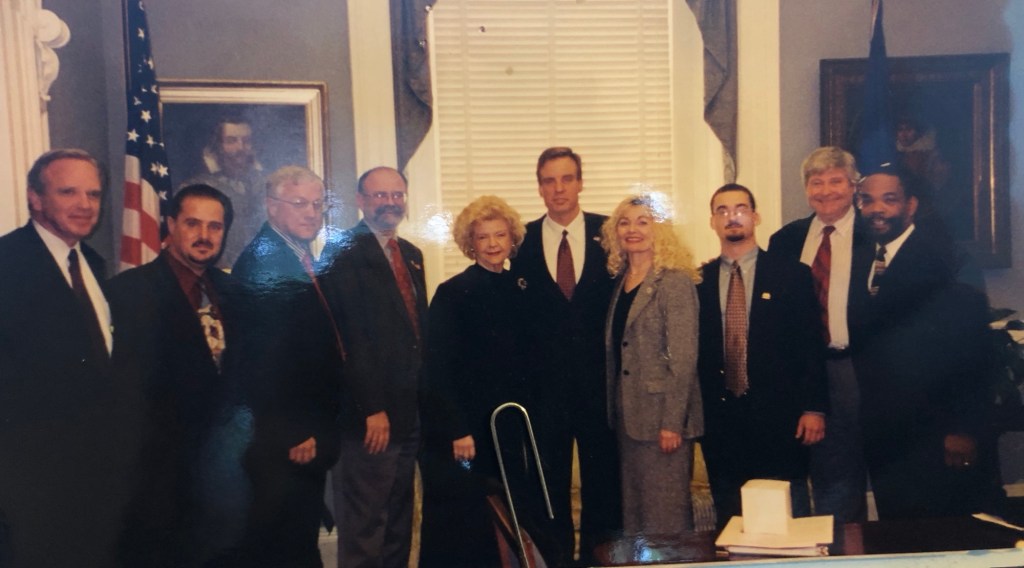
Circa 2002 at the Virginia Capitol during a meeting with then-Governor Mark Warner, with Ben by my side. We made a formidable team.
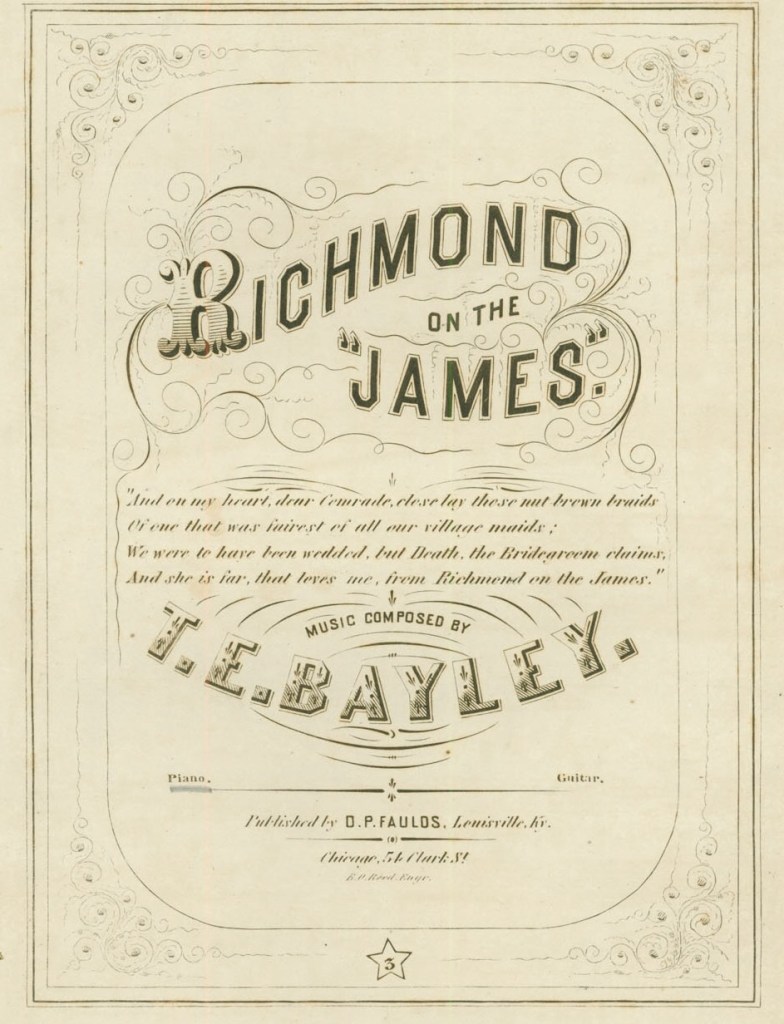
A day late with our usual #fredonhistory post—but when a song’s story has been traveling for more than a century and a half, one more day seems forgivable.
We love music around here.
All kinds, but especially the traditional songs: the ones that carry names, places, grief, faith, and some trace of every voice that kept them alive. Because of this, I listen to a great deal of bluegrass, and one track – “Richmond on the James” – from Alison Krauss’s latest album sent me down a particularly long historical trail.
Old songs, like old land, sometimes come with a tangled chain of title.
In 1863, the song first appeared, attributed to Kentucky composer, T.E. Bayley. The following year, the music book, “Southern Soldier’s Prize Songster,” published in Mobile, Alabma, printed substantially the same ballad and attributed it to a G. T. Burgess. So while this latter version is not necessarily the song’s birthplace, it is one early stopping place in a song already on the move.
At the center of the song’s story is a young soldier dying near Richmond, in the midst of the War Between the States, while a friend from boyhood remains beside him. He sends his sword home, asks that a lock of hair be given to his mother, remembers his sister, and speaks of the young woman he expected to marry.
Fast forward nearly a century later, in the early 1940s, and the earliest surviving and known recording appears.
The song kept traveling.
Musician Tim Eriksen says he first heard it on a cassette in 1989 and carried the song for years. Anne Hills and Cindy Mangsen also included it on their 1994 album, “Never Grow Old.” Eriksen later gave it to Alison Krauss, who debuted her version in her 2025 album, “Arcadia.”
Krauss has said that hearing a woman tell the soldier’s story makes us feel how young and innocent those men were—and how little they could know about what war would ask of them.
That may be why her performance is so moving and soulful. It does not make the battlefield grand. It draws us close to a son, a brother, a friend, and a promised husband who will not be coming home.
That is the beautiful mystery of traditional music. No generation owns it. One person writes it down. Another remembers it. Another changes a line. Another sings it into a recorder. Another carries it onto a modern album.
Ink becomes voice, voice becomes memory, and memory becomes music again.
A song can outlive the war in which it first appeared. It can cross regions, generations, and centuries and still find its way to a porch, a fiddle, a guitar, and someone willing to listen.
And so, from our #ChuckatuckLife porch to yours… may the old songs never lack a voice to carry them home.
Most folks have heard of Pickett’s Charge and the battle of Gettysburg. Fewer know that one of the family stories connected to that famous moment in American history runs right through Chuckatuck.
Meet James Jasper Phillips.
Born in Nansemond County in 1832, Phillips came from a local family tied to the Chuckatuck area. After graduating from the Virginia Military Institute in 1853 — ranked near the top of his class — he returned home and became an educator.
In 1854, he helped establish what became known as the Chuckatuck Military Academy, also remembered as the Chuckatuck Male and Female Institute. Imagine that for a moment: before public schools as we know them today, Chuckatuck had its own school, led by a young VMI-trained teacher, with boys and girls receiving an education right here in the community.
But history soon came calling.
When the War Between the States began, Phillips helped organize the Chuckatuck Light Artillery, a local company of men from this area. Despite the name though, the unit became Company F of the 9th Virginia Infantry. Phillips was elected captain, later rose to colonel, and served through some of the hardest fighting of the war. He was wounded at Gettysburg during Pickett’s Charge, and was later captured at Sailor’s Creek just days before the surrender at Appomattox.
And here is where the family story becomes even more interesting…
James Jasper Phillips was actually the uncle of LaSalle “Sallie” Corbell Pickett, the Chuckatuck-born wife of General George E. Pickett! (… their story will definitely be a future post!) Through the Phillips and Corbell families, our little corner of Nansemond County had a direct family connection to one of the most famous names and moments of the Civil War.
That is what makes local history so powerful.
The great events of history may be remembered in capitals, battlefields, and textbooks — but they were lived by real people from real places. Sometimes, those places are closer than we realize.
Chuckatuck has always been more than a spot on the map. It has been a crossroads of families, faith, education, service, hardship, memory, and story.
And James Jasper Phillips is one of those stories worth remembering.
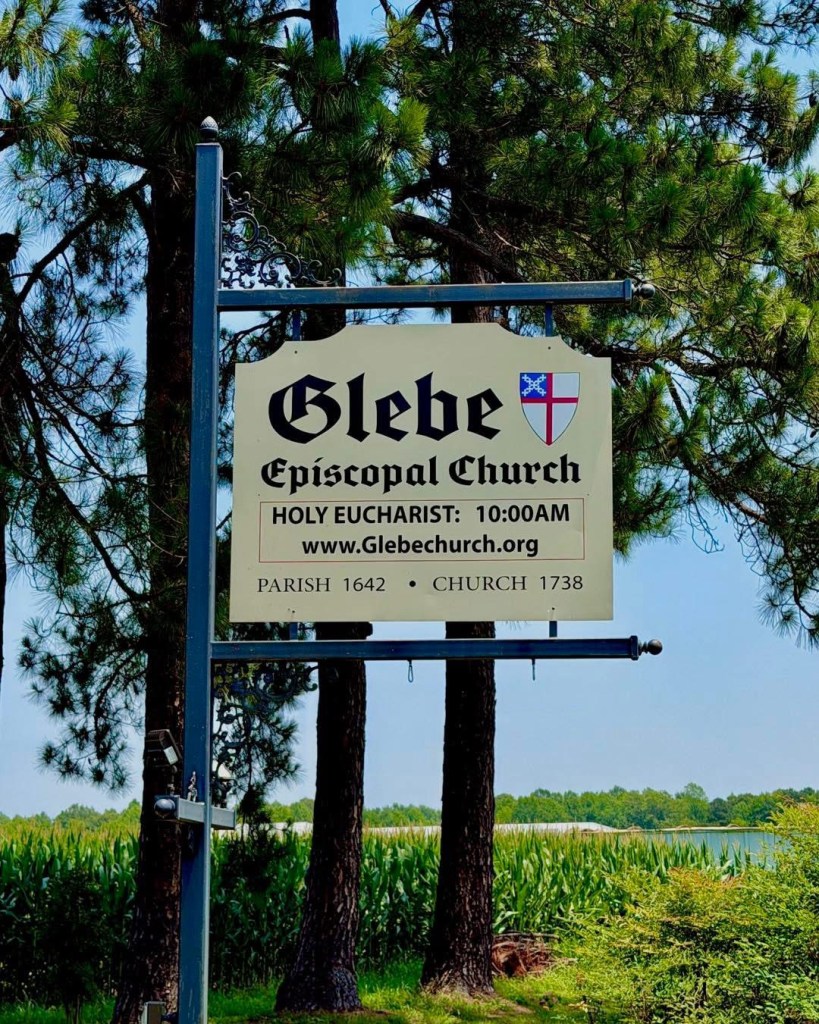
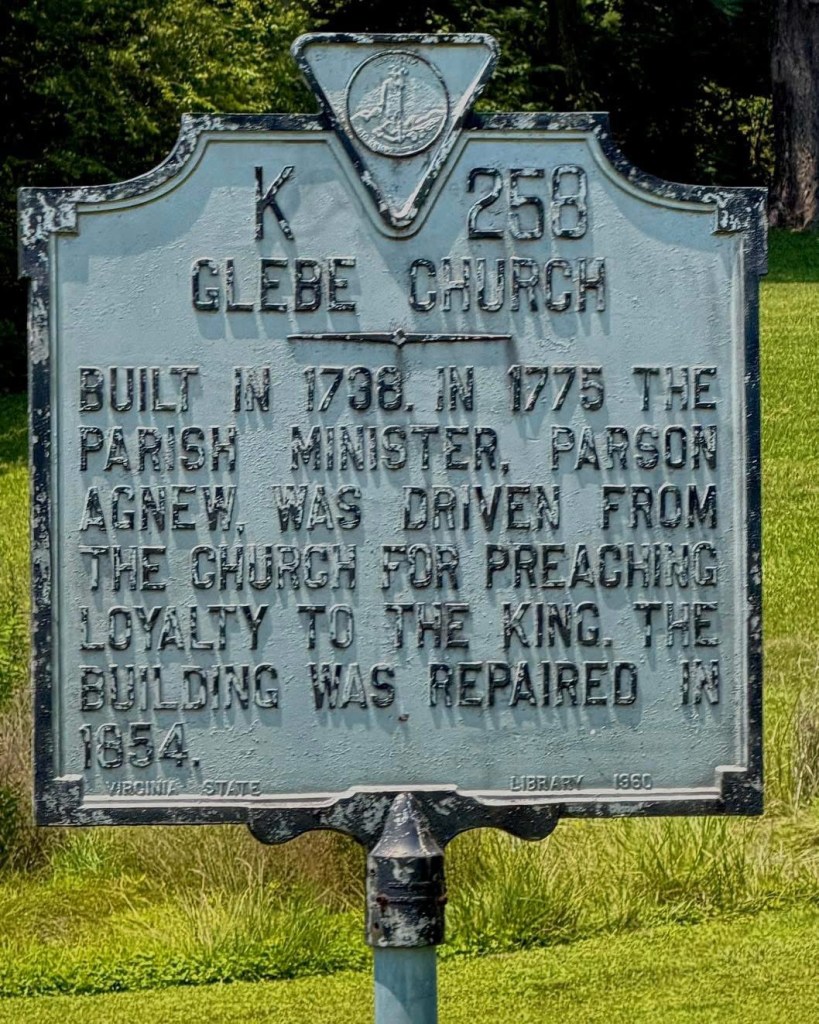
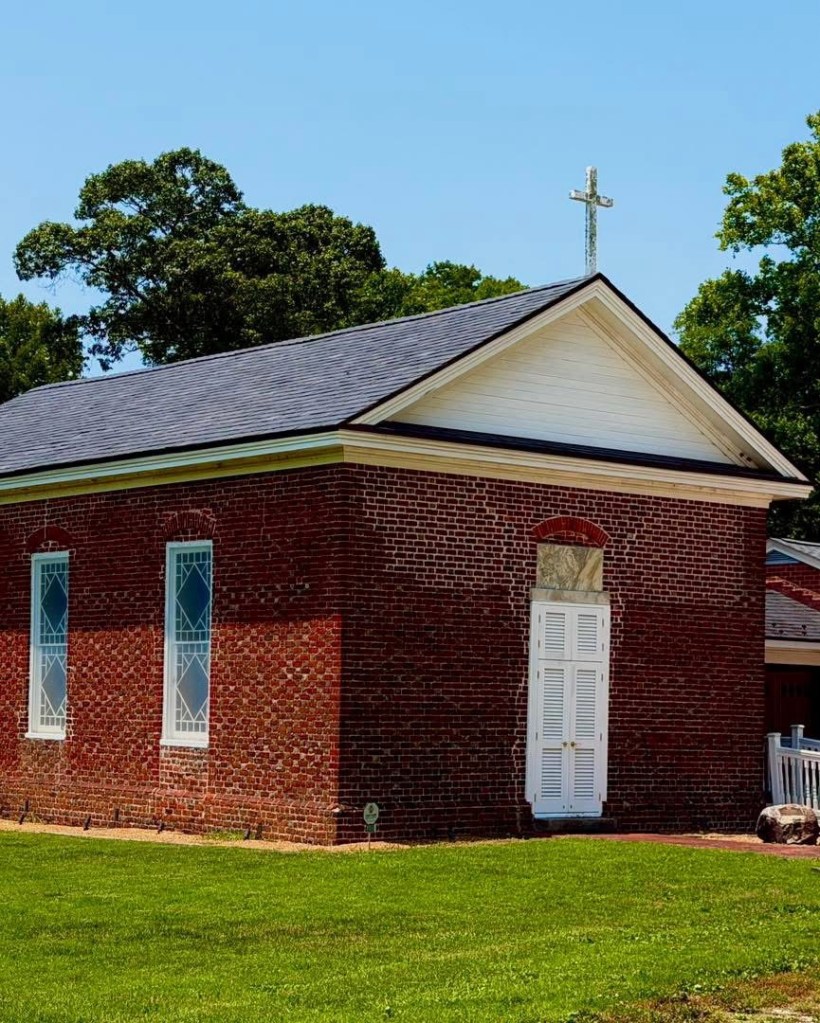
Last week, we talked about the “original” King’s Highway. And along that same old road, in what is now the Driver community, stands Glebe Church originally known as the Bennett’s Creek or “Lower Parish” Church, a historic place where local life and revolutionary feeling collided.
Interestingly, Glebe Church has a direct connection to Chuckatuck. Because of the lack of clergy, particularly in rural areas during colonial times, the minister at Glebe Church – the Rev. John Agnew – also served as minister at St. John’s Church in the Chuckatuck Parish. So, this isn’t the story of some distant colonial minister. It’s the story of a man whose ministry reached into Chuckatuck and whose choices reflected the divisions of the Revolution.
In 1775, with revolutionary feeling rising across Virginia, Agnew stepped into the pulpit at Glebe Church to influence his flock. As an Anglican clergyman, he was loyal to the Crown, and on this particular Sunday he took as his text the words of Jesus: “Render unto Caesar the things that are Caesar’s.” But the congregation knew where he was headed.
Agnew began his preaching, warning against disloyalty to lawful government — and in his view, disloyalty to the King. But before he could finish, William Cowper, a local vestryman and magistrate, stood and ordered him down from the pulpit.
Agnew reportedly replied, “I am doing my Master’s business.”
Cowper answered with the question that captured the Revolution: “Which master? Your Master in heaven, or your master over the seas?”
That question would mark the conclusion of the sermon. Agnew walked out of the Church that day, never returning.
During the War, Rev. Agnew left Virginia, casting his lot fully with the Loyalist cause. He served as a Chaplain with the “Queen’s Rangers,” a regiment in which his son was serving as an officer. In 1781, both father and son were captured by a French squadron while aboard the British frigate Romulus. They would be imprisoned for the remainder of the war in Rhode Island, Saint-Domingue — present-day Haiti.
Of course, because of the Colonies’ success, the Agnews found that the old world they had known was gone. They were unwelcome to return to Virginia and the new American republic, so they returned to England. But Rev. Agnew eventually immigrated to New Brunswick, Canada, among other loyalist exiles. He lived and prospered there – serving for at least one term in their House of Parliament – until his death in 1812.
This is why local history matters. The Revolution wasn’t simply America versus Great Britain. It divided families, neighbors, congregations — even pulpits.
Along the old King’s Highway in Chuckatuck and Nansemond County, people faced the same question that echoed across the colonies: When Caesar and conscience collide, who gets the final word?
As we remember America’s 250th Anniversary, stories like this remind us that independence wasn’t only declared in Philadelphia on July 4th — it was lived, debated, and defended here at home, along the roads, in the churches, and among the people who would help shape a new nation.
Most people driving through Chuckatuck today have no idea they may be traveling over a road system older than our country itself.
Long before there was a State Route 10 or 125, or even a good ol’ U.S. of A., this part of Virginia was tied into what was known in colonial times as King (Charles II’s) Highway.
But the story starts even earlier than that.
Many of Virginia’s early roads followed older American Indian paths — trails that crossed rivers and creeks at the narrowest, most practical points. As English settlers arrived in the 1600s, those paths slowly became primary roads, mail routes, ferry routes, and eventually pieces of a larger highway system connecting communities across the colonies.
By the 1700s, the “King’s Highway” stretched in various forms for more than 1,300 miles, linking Boston, Massachusetts, to Charleston, South Carolina. And here in Tidewater, that route helped connect travelers moving between Richmond and Petersburg east to Suffolk, Portsmouth/Norfolk, and onward into North Carolina.
That made Chuckatuck more than just a quiet village. It made Chuckatuck a crossroads within a much larger network of travel.
Because of its location near both the Nansemond River and Chuckatuck Creek, this area became important for farming, trade, and transportation. Tobacco, corn, cotton, livestock, supplies, mail, merchants, soldiers, and the like all moved through here.
And one of the most important local connections along the King’s Highway was of course, Sleepy Hole Ferry.
Before modern bridges, ferries were lifelines. Sleepy Hole Ferry connected both sides of the Nansemond River and served as a critical crossing point for travelers, commerce, and — at times — armies.
Speaking of, during the American Revolution, Benedict Arnold’s British troops crossed near Sleepy Hole Ferry in January of 1781, as they were returning from a raid on Richmond. Famed Continental General Marquis de Lafayette would do the same, chasing after Arnold. And later that same year, British Commanding General Cornwallis crossed on the Sleep Hole Ferry on his way toward Portsmouth.
Think about that for a second.
British and Continental troops moving through this area — right here near Chuckatuck — during the fight for American independence.
That is what makes local history so fascinating.
History did not only happen in Boston, Philadelphia, Williamsburg, or Yorktown.
It happened along quiet roads. It happened at ferry crossings.
It happened in small communities like Chuckatuck that helped connect early America together.
And as we approach America’s 250th birthday, roads like the King’s Highway remind us that the story of America runs not just through the major cities or battlefields that make the history books, but through the places we pass by every day.
Even right here at home.
So from my porch to yours — cheers to more local history, until the next time!
Image: Excerpt from Map of Isle of Wight and part of Nansemond, made under the direction of A.H. Campbell and J.F. Gilmer, Chief Engineer’s Office, Army of Northern Virginia, 1864. Courtesy of the Archives of the United States Military Academy.