Typically on a day like today the history nerd in me tries to attend a lecture or do something to commemorate the event. Unfortunately, I was unable to participate in any of the local Juneteenth activities due to some other obligations, but that did not keep me idle.
This afternoon, I decided to take a walk and reflect on the occasion. I walk a lot around downtown. My normal stroll from the office takes me across the railroad tracks following Main Street to Suffolk’s historic Cedar Hill Cemetery. I find a lot of inspiration there. Today, I intentionally took a different route… and headed along Market Street to Oak Lawn Cemetery.
For those not familiar, Oak Lawn is located across the street from City Hall – adjacent to the City Registrar and Social Services building. Though there was a cemetery there prior, this was established officially as “Oak Lawn Cemetery” in 1885 and thereafter became the final resting place of a literal “Who’s Who” of Suffolk African-American leaders and their families. But I digress…

So why did I go there? Well I’m not quite sure one can begin to talk about history without going to the source of it all and for me that has always been through visits to cemeteries. To this very point, I recalled from a prior visit some years back that there were a number of veterans buried at Oak Lawn. Specifically, Union veterans, which made me ask who are they and what is their story? I really wasn’t sure what I would find, and quite candidly, did not really think I would make a Juneteenth connection, as this celebration really started off as a Texas holiday (I should mention that here on the east coast, most freed slaves recognized January 1st as “Emancipation Day” and held celebrations & parades of this well into the early 1900s).
Today though, I can now tell a Suffolk-centric Juneteenth story, of course only after a little sleuthing later this evening, chasing some rabbit holes (literally) at the cemetery, and some good old fashioned fate on my side.
Allow me to introduce you to Redmond Parker.
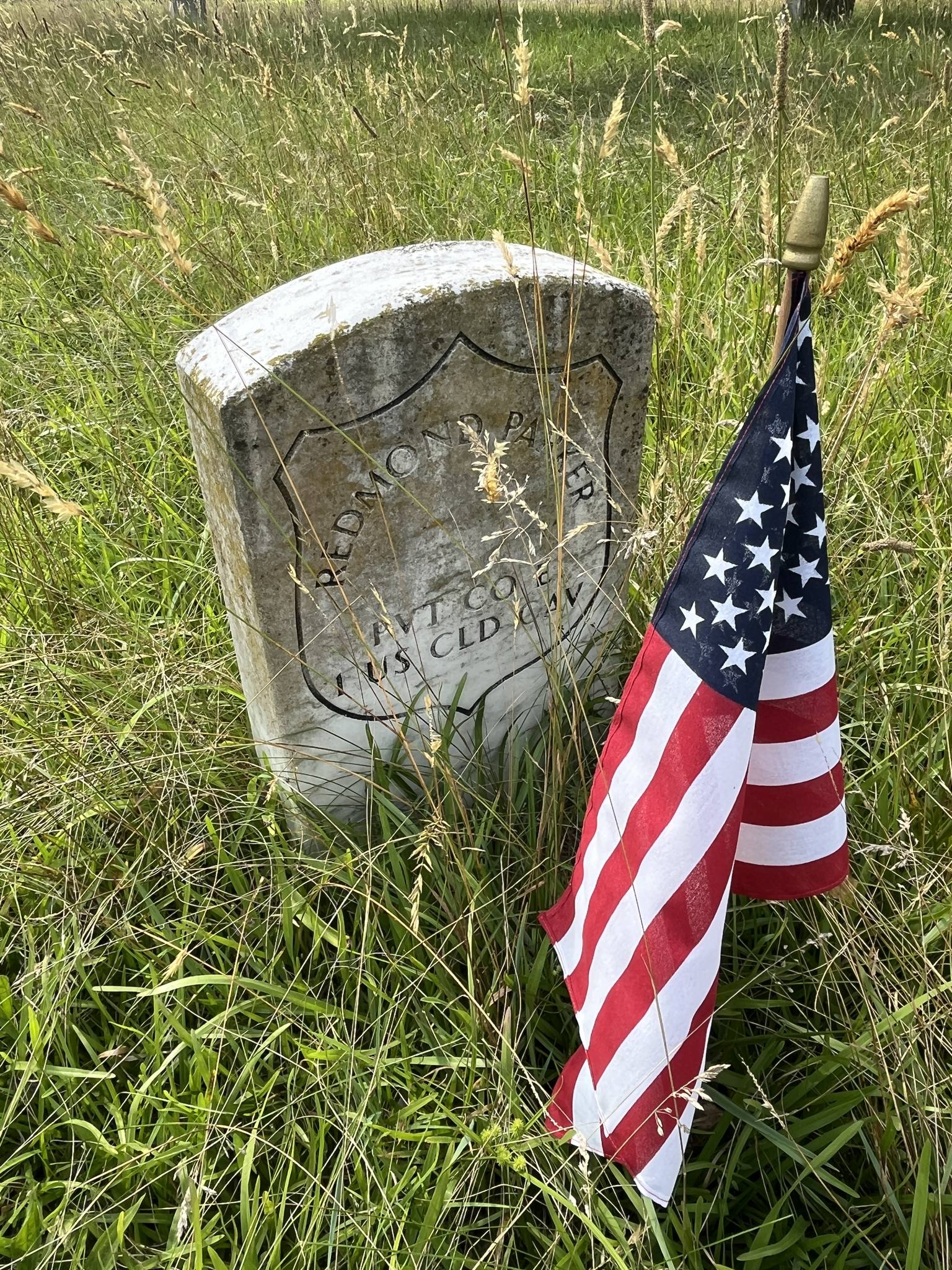
Redmond Parker was a native of Hertford County, North Carolina, and by occupation a farmer when he enlisted on December 12, 1863 at Camp Hamilton/Fort Monroe in Company E of the 1st Regiment United States Colored Cavalry. One website focusing on this regiment’s history (1stuscoloredcavalary.wordpress.com) described the early organization as including “free men, freedom seekers and white officers from the United States and abroad.” In researching Parker’s compiled service records from the National Archives, the Company muster book described him as being twenty years old and 5’8” tall, with black eyes, hair, and complexion.
Parker was briefly promoted to Sergeant of his Company, but then reduced to ranks as a Private by February 1864 for unknown reasons. His service with the regiment continued on though without interruption, the regiment serving on the peninsula until May of 1864. They then participated in the battles comprising the Bermuda Hundred Campaign and the Siege of Petersburg up to August of 1864. Following this, Parker’s Company E was detached to serve at Fort Powhatan and Harrison’s Landing from August 1864 to May 1865. After the surrender of the Army of Northern Virginia and Tennessee occurred, the regiment was ordered to Texas.
And that is where we make our Juneteenth connection. The regiment left Virginia on June 10, 1865 from City Point (Hopewell), and by the time they reached Texas soil – of course sometime shortly after June 19 – U.S. Army Major General Gordon Granger had issued his General Order No. 3, announcing the freedom of all slaves in Texas.
As for Redmond Parker, while initially I was unsure of his actual status, I located a Freedman’s Bureau record confirming that he was a slave in 1863, and preliminary research suggests he was on the Hertford County plantation of Oris Parker. Thus, it is presumed he either escaped or was freed by passing Union troops, enabling him to go Fort Monroe and join the Union army. But regardless of status, he and his comrades arrived to a newly freed Texas in the summer of 1865. That irony of their situation and freedom some time before was probably not lost on them. The 1st Regiment Colored Cavalry spent their time here occupied in patrols along the Rio Grande. On February 4, 1866, the regiment and Redmond Parker were mustered out at Brazo Santiago following twenty six months of service.
After the War, Parker came to Virginia and settled in Princess Anne County (now Virginia Beach), taking a position as a laborer for a wage of $10.00 a month. In the early 1870s, he married Vinnie Jenkins and began a family, settling in the Holy Neck community of Nansemond County. It was here that he and his wife raised six children. Parker later took a civil service job at the Norfolk Navy Yard, initially as a general laborer and worked his way up through the trades as a mason and a teamster. He continued in this employment for several decades to come.
At the age of 74, Redmond Parker passed away from a stroke on December 29, 1918. An obituary in the Norfolk Ledger-Star noted that he was “one of Suffolk’s oldest and most respected colored citizens… he was a member of the local camp of old veterans, having served in the Civil War.” His funeral was conducted at the First Baptist Church, Mahan Street, followed by burial at Oak Lawn.

And so on this June 19th, not only do you know a real Juneteenth story, you know one with a connection to Suffolk.
 Fred~on~History