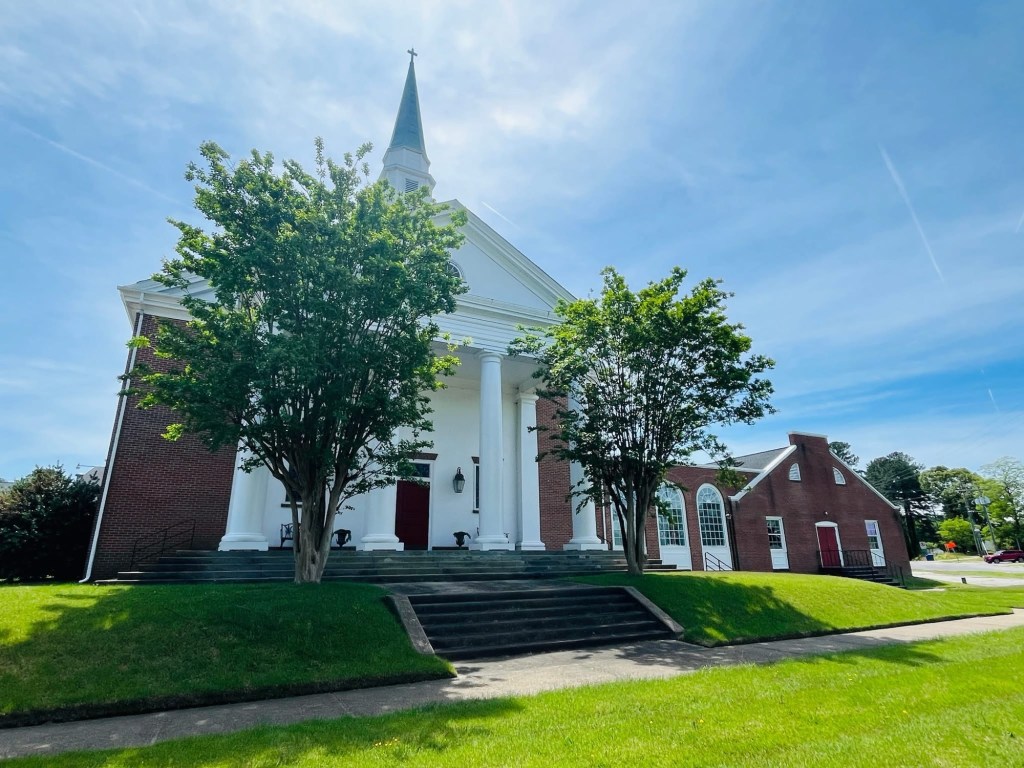
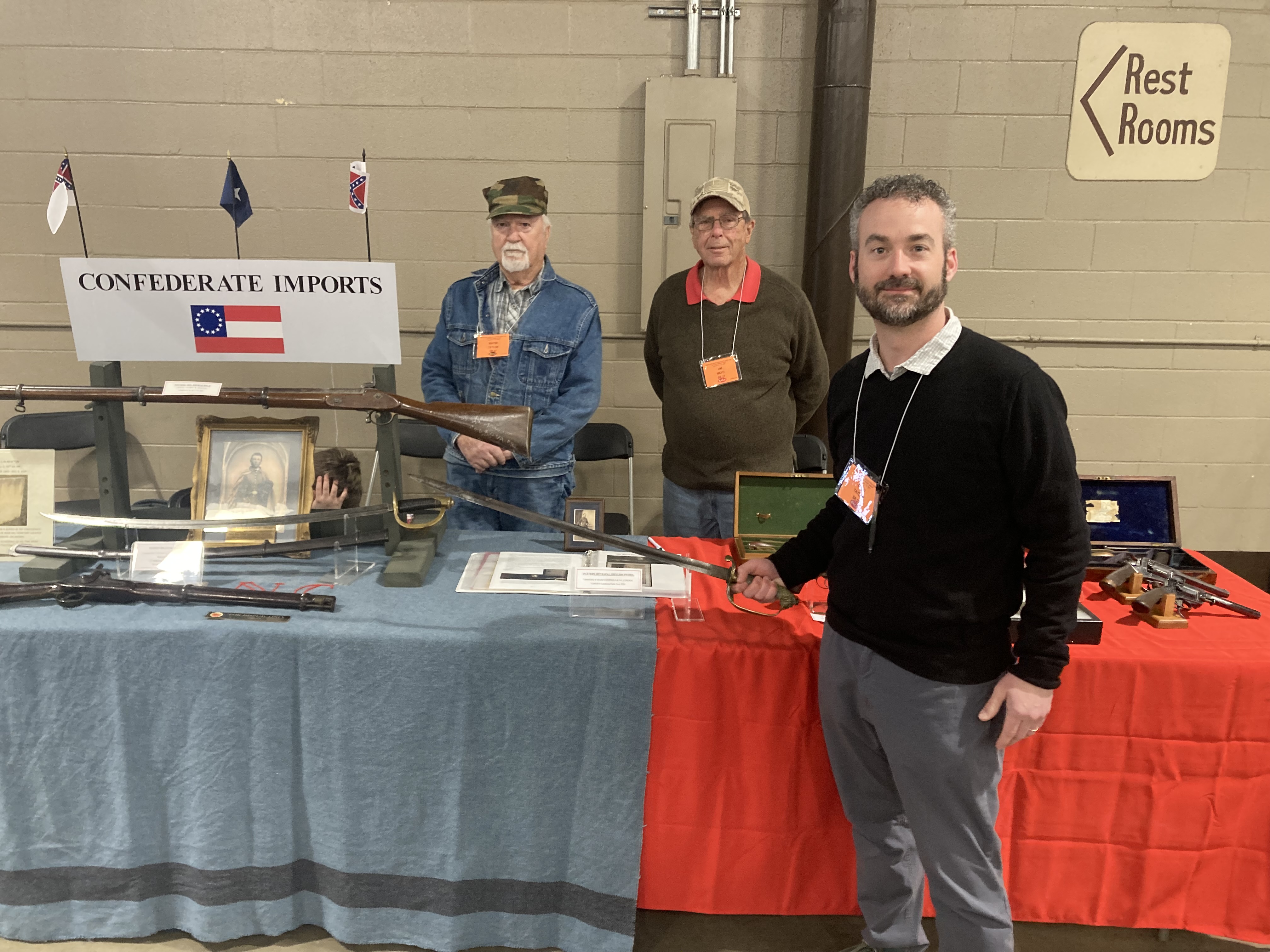
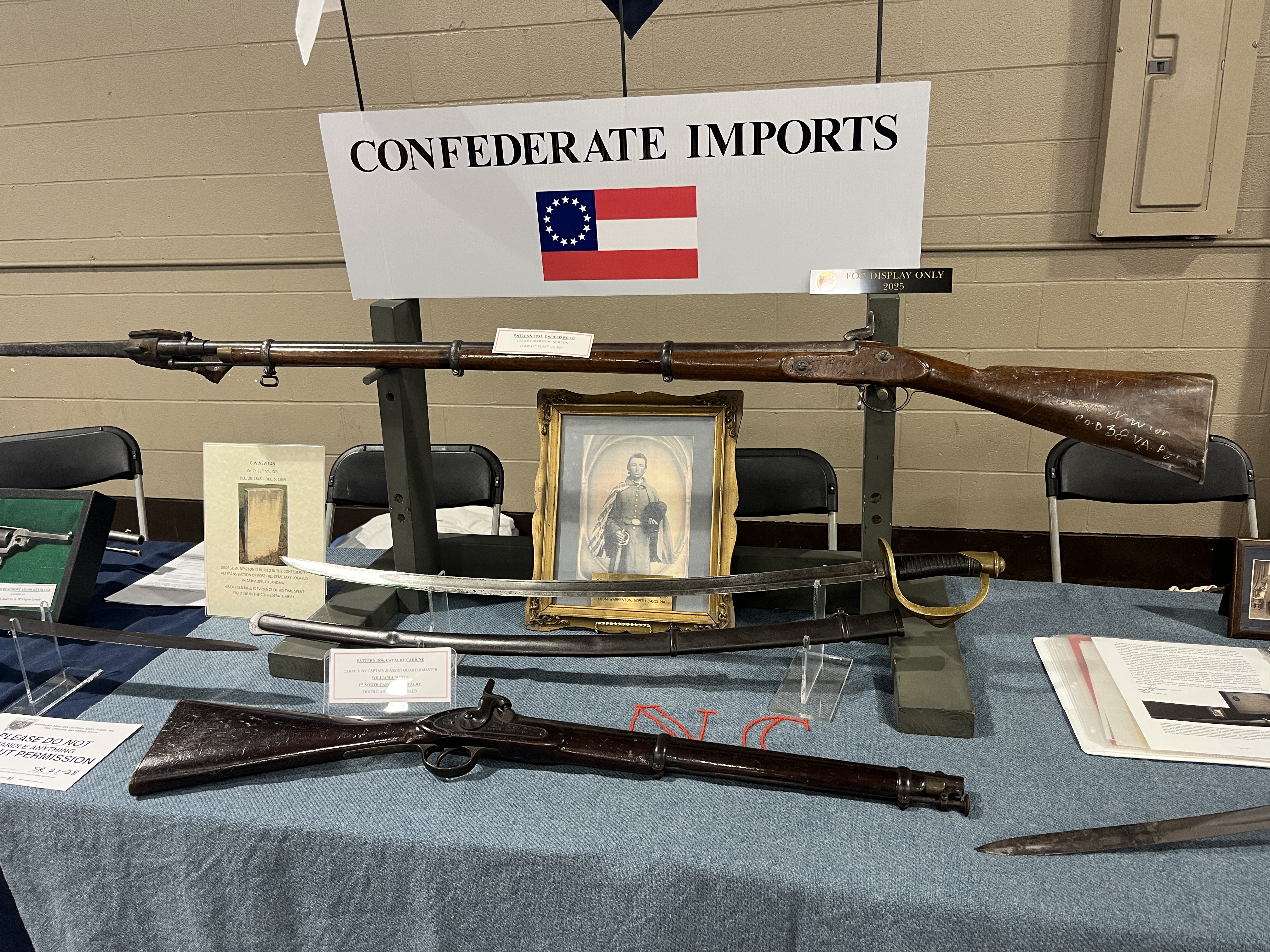
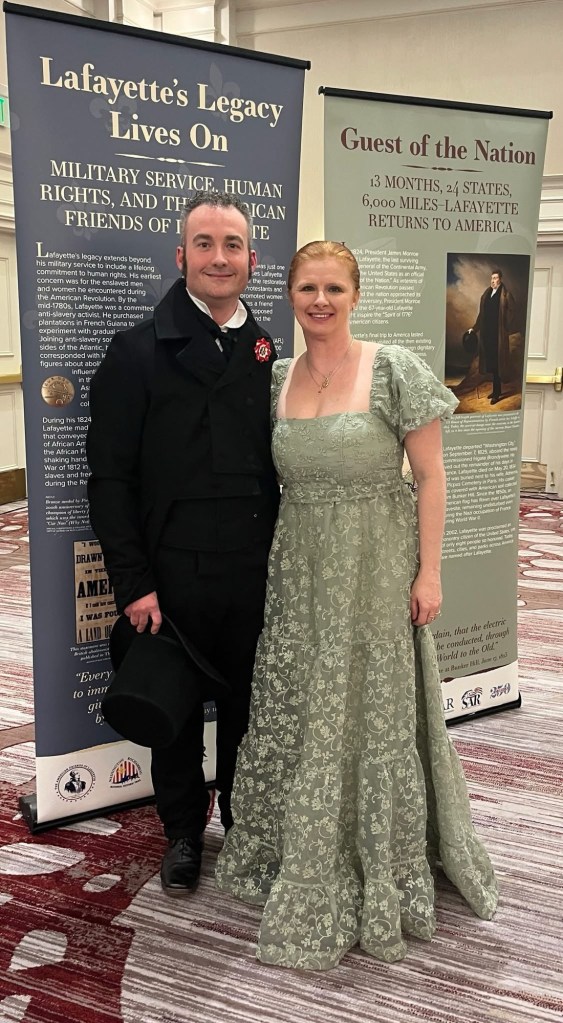
Channeling my inner “Professor” to talk Brunswick County history with the Lake Gaston Ladies Club.
Pea Hill Plantation History Revealed
Thanks to the Lake Gaston Gazette for covering this program!
Channeling my inner “Professor” to talk Brunswick County history with the Lake Gaston Ladies Club.
Pea Hill Plantation History Revealed
Thanks to the Lake Gaston Gazette for covering this program!
It seems like these last few weeks have been filled with nothing but news of illness and loss; and again this morning I woke up to learn of the passing of another friend.
I was first introduced to Nicholas Lusher back in 2018, as I began my journey into the early history of photography in Bermuda. To say he was an expert – and I do not toss that word around lightly – was an understatement, having an academic, professional, and personal/family background that did in fact make him what his obituary referred to as an “internationally esteemed art and antiques dealer dedicated to preserving the island’s cultural heritage.” But he was so much more than the acclaimed Caribbean and New York art dealer on the surface.
Upon learning of my interests, Nicky welcomed me into his world immediately, excited to provide research material, make referrals, and open doors that I otherwise would never have had as an outsider to Bermuda. We collaborated for several years thereafter as collectors, historians, and ultimately as friends. Once I published my story on photographer Samuel W. Gault (which I naively thought would be the end of my research), we remained in contact to share new historical findings and “talk shop.” And despite the fact he was in the business to find and sell art, he would frequently tip me off when Gault images would pop up in the marketplace, giving me the first chance on them.
I will forever be grateful for Nicky’s mentorship and the legacy he leaves in the art world, but most of all I send my deepest condolences to his family, of which I know he so loved and cherished even more. Requiescat in pace, my friend.
Among many others who I thank for their service today, I remember my grand-uncle, Burnie Robert Taylor (pictured here as a young man, on the right.)

Uncle Burnie was born in Brunswick County, Virginia, in 1893, but raised primarily just across the state line in Roanoke Rapids, North Carolina. He enlisted at the age of 22 in Company F of the 3rd North Carolina Infantry (National Guard) on June 26, 1916, prior to the American entry into World War I, and spent his early training in El Paso, Texas, as a part of General Pershing’s expedition against Pancho Villa.
His unit was drafted and federalized in August 1917, becoming the 120th Infantry, a part of the 30th Division, under the Command of British General Henry Rawlinson during much of the War. Uncle Bernie rose to the rank of Sergeant, and during what was known as the Hundred Days Offensive, was wounded in action on October 9, 1918. According to the family history, he was was felled by machine gun fire to his left hip, and lay on the field wounded for close to a day somewhere near Cambrai, France. He was eventually rescued, and spent the coming months at the Red Cross Military Hospital (No. 21) at Paignton, Devon, England. In December 1918, Uncle Burnie was transported to Liverpool, enroute back to the United States. He arrived in January 1919, and was discharged from Camp Lee, Virginia.
After the War, he returned home to Roanoke Rapids, North Carolina, where he worked the rest of his life as a textile mill worker. He was married to Fannie Eula Collier, and he passed away on January 23, 1976.


Tired of just another haunted hay ride or spooky house?
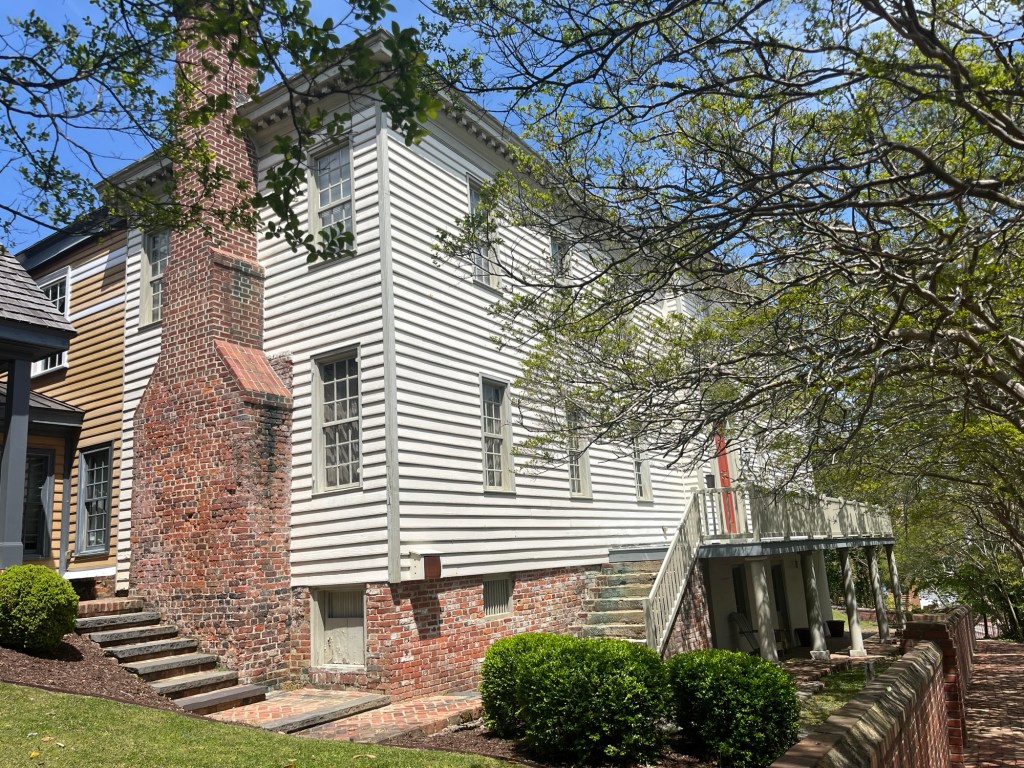
Join us at Suffolk’s oldest house museum – Riddick’s Folly – for an evening of history and readings of the famed macabre writer, Edgar Allen Poe.
The evening will begin with a social period with light hors d’oeuvres from 6:00 – 6:30 PM, followed by the program at 6:35 PM.
This event is free and open to the public, but due to limited seating, please RSVP to riddicksfolly@verizon.net or call 757-934-0822.
We love our “Folly” – thanks to Myles Henderson at WTKR News 3 for sharing our great story!
Here is the link:
Typically on a day like today the history nerd in me tries to attend a lecture or do something to commemorate the event. Unfortunately, I was unable to participate in any of the local Juneteenth activities due to some other obligations, but that did not keep me idle.
This afternoon, I decided to take a walk and reflect on the occasion. I walk a lot around downtown. My normal stroll from the office takes me across the railroad tracks following Main Street to Suffolk’s historic Cedar Hill Cemetery. I find a lot of inspiration there. Today, I intentionally took a different route… and headed along Market Street to Oak Lawn Cemetery.
For those not familiar, Oak Lawn is located across the street from City Hall – adjacent to the City Registrar and Social Services building. Though there was a cemetery there prior, this was established officially as “Oak Lawn Cemetery” in 1885 and thereafter became the final resting place of a literal “Who’s Who” of Suffolk African-American leaders and their families. But I digress…
So why did I go there? Well I’m not quite sure one can begin to talk about history without going to the source of it all and for me that has always been through visits to cemeteries. To this very point, I recalled from a prior visit some years back that there were a number of veterans buried at Oak Lawn. Specifically, Union veterans, which made me ask who are they and what is their story? I really wasn’t sure what I would find, and quite candidly, did not really think I would make a Juneteenth connection, as this celebration really started off as a Texas holiday (I should mention that here on the east coast, most freed slaves recognized January 1st as “Emancipation Day” and held celebrations & parades of this well into the early 1900s).
Today though, I can now tell a Suffolk-centric Juneteenth story, of course only after a little sleuthing later this evening, chasing some rabbit holes (literally) at the cemetery, and some good old fashioned fate on my side.
Allow me to introduce you to Redmond Parker.
Redmond Parker was a native of Hertford County, North Carolina, and by occupation a farmer when he enlisted on December 12, 1863 at Camp Hamilton/Fort Monroe in Company E of the 1st Regiment United States Colored Cavalry. One website focusing on this regiment’s history (1stuscoloredcavalary.wordpress.com) described the early organization as including “free men, freedom seekers and white officers from the United States and abroad.” In researching Parker’s compiled service records from the National Archives, the Company muster book described him as being twenty years old and 5’8” tall, with black eyes, hair, and complexion.
Parker was briefly promoted to Sergeant of his Company, but then reduced to ranks as a Private by February 1864 for unknown reasons. His service with the regiment continued on though without interruption, the regiment serving on the peninsula until May of 1864. They then participated in the battles comprising the Bermuda Hundred Campaign and the Siege of Petersburg up to August of 1864. Following this, Parker’s Company E was detached to serve at Fort Powhatan and Harrison’s Landing from August 1864 to May 1865. After the surrender of the Army of Northern Virginia and Tennessee occurred, the regiment was ordered to Texas.
And that is where we make our Juneteenth connection. The regiment left Virginia on June 10, 1865 from City Point (Hopewell), and by the time they reached Texas soil – of course sometime shortly after June 19 – U.S. Army Major General Gordon Granger had issued his General Order No. 3, announcing the freedom of all slaves in Texas.
As for Redmond Parker, while initially I was unsure of his actual status, I located a Freedman’s Bureau record confirming that he was a slave in 1863, and preliminary research suggests he was on the Hertford County plantation of Oris Parker. Thus, it is presumed he either escaped or was freed by passing Union troops, enabling him to go Fort Monroe and join the Union army. But regardless of status, he and his comrades arrived to a newly freed Texas in the summer of 1865. That irony of their situation and freedom some time before was probably not lost on them. The 1st Regiment Colored Cavalry spent their time here occupied in patrols along the Rio Grande. On February 4, 1866, the regiment and Redmond Parker were mustered out at Brazo Santiago following twenty six months of service.
After the War, Parker came to Virginia and settled in Princess Anne County (now Virginia Beach), taking a position as a laborer for a wage of $10.00 a month. In the early 1870s, he married Vinnie Jenkins and began a family, settling in the Holy Neck community of Nansemond County. It was here that he and his wife raised six children. Parker later took a civil service job at the Norfolk Navy Yard, initially as a general laborer and worked his way up through the trades as a mason and a teamster. He continued in this employment for several decades to come.
At the age of 74, Redmond Parker passed away from a stroke on December 29, 1918. An obituary in the Norfolk Ledger-Star noted that he was “one of Suffolk’s oldest and most respected colored citizens… he was a member of the local camp of old veterans, having served in the Civil War.” His funeral was conducted at the First Baptist Church, Mahan Street, followed by burial at Oak Lawn.
And so on this June 19th, not only do you know a real Juneteenth story, you know one with a connection to Suffolk.
Here’s to some Friday evening local #fredonhistory in honor of the 162nd anniversary of the battle of Hampton Roads, March 8-9, 1862.
From my collection of images is this cabinet card of Confederate States Navy Commander William Augustin Webb.

Born in 1824 in Virginia, William A. Webb hailed from a strong maritime family – his father Thomas Tarleton Webb serving several decades in the U.S. Navy and reached the distinguished rank of Captain. Following in his father’s footsteps, the younger Webb entered the Navy at an early age, and also quickly demonstrated his capabilities. By 1854 he had been promoted to Lieutenant.
Upon the outbreak of the War Between the States, Webb resigned and offered his services to Virginia and ultimately the Confederacy. He was commissioned a 1st Lieutenant and initially assigned to duty in Florida, but returned to Virginia for service with the James River Squadron by the spring of 1862. Here, Webb was placed in command of the Teaser, a converted eighty-foot tugboat armed with only two guns – 32 lb and 12 lb cannon.
It was in this service in March of 1862, the Teaser (and Webb) would distinguish itself in its supporting role alongside the CSS Virginia (Merrimack) as it clashed with unprepared wooden gunboats and ultimately the U.S.S Monitor. In the after-action report of Captain Franklin Buchanan, he noted that the Squadron and “W. A. Webb, of the Teaser, deserves great praise for their gallant conduct throughout the engagement. Their judgment in selecting their positions for attacking the enemy was good; their constant fire was destructive, and contributed much to the success of the day. The general order under which the squadron went into action required that, in the absence of all signals, each commanding officer was to exercise his own judgment and discretion in doing all the damage he could to the enemy, and to sink before surrendering.”
After the battle, Webb went on to serve in a variety of roles with the CS Navy and was promoted to Commander by 1863. There is much more I can add about his time from this point until War’s end, but I will save that story for another day!
More importantly, if you want to learn more about the Battle of Hampton Roads, I invite you out to The Mariners’ Museum and Park this weekend as they commemorate this historic event with opportunities to view artifacts, as well as enjoy a number of lectures and programs for all ages.
North Carolina’s Confederate Hospitals, 1861-1863, Volume I by Colonel Wade Sokolosky (Ret.)
Reviewed by Fred D. Taylor
Having been a fan of Colonel (Ret.) Wade Sokolosky’s prior works related to Tar Heel Civil War history, I was excited to read his latest project, North Carolina’s Confederate Hospitals, 1861-63, Volume 1 (Fox Run Publishing, 2022).
In recent memory, although some minor scholarship has been devoted to the subject of North Carolina and its Confederate hospitals, without question, Sokolosky’s book brings together a complete history on this oft overlooked topic. Starting with background on the organization of the Confederate medical department, Sokolosky leads the reader through the various officers and politicians involved with the creation of the state’s medical system. Further chapters present full coverage of the day to day operations of the hospitals in North Carolina (and some outside of the state that NC contributed toward) during the period 1861-63, to include perspectives from numerous individuals from Doctors to Nurses, Matrons, and a variety of other key personnel.
Clearly, NC’s Confederate Hospitals checks many boxes for professional historians, students, and the average lover of North Carolina Civil War history alike. As a reference work, the book is a go to for when and where hospitals operated, their capacities, and who ran them – whether it be the Confederate government, the state of North Carolina, or private efforts from local aid societies. The book is similarly a resource to the historian or genealogist studying a particular soldier or civilian involved within the system, whether it be in a medical role or as a patient. And for the casual reader, the book gives a unique look behind the curtain of the care for sick and wounded Confederate soldiers in the midst of War.
In sum, I highly recommend NC’s Confederate Hospitals, and am eager to see Colonel Sokolosky complete his efforts on this unique story with the publication of Volume II.
As many of you know I am fascinated by early photography, and collect images primarily from the 1850s-60s period, comprising daguerreotypes, ambrotypes, and tintypes. Most of these are from North Carolina, where I have deep family roots. Although my focus for the last few years has been telling the history of soldiers, I am always interested in a good story, and that is where this one begins.
By way of background, finding an identified image from this period is always a challenge. You are lucky if someone wrote an inscription or left a note identifying the subject. Likewise, most images you see from the period are of individuals, usually taken in a photographer’s gallery or in a make-shift “studio” by an itinerant. Rarely do you see an outdoor image. So when I came across the image posted here, the rare outdoor scene, I was intrigued. But when I learned it was identified to North Carolina, I was in awe.
The image itself is a ¼ plate ambrotype taken on clear glass, and inside was the following writing on a piece of paper as follows:
“Picture of Dr. Saml Boyden at his home in Gold Hill.”
With these details, the research hunt began!
Samuel G. Boyden was not a native “Tar Heel,” but was actually born in Deerfield, Massachusetts, about 1815. He moved to North Carolina at the age of eighteen, likely following in the footsteps of another local kinsmen, Nathaniel Boyden (lawyer, member of Congress, and NC Supreme Court justice). After reaching the age of majority, Samuel began studying medicine, and is said to have graduated with honors. He ultimately settled in Salisbury as a Doctor. I find the first mention of him in 1841 under the practice of “Henderson & Boyden.” In 1847, he moved to the nearby Town of Gold Hill, where he formed “Drs. Rice & Boyden.”
I cannot lose the opportunity here to talk about Gold Hill. Organized as a Town in 1843, Gold Hill was a bustling gold mining town, years before the rush began in California. In fact, Gold Hill was the most significant mining area in the state of North Carolina, and one of the most prosperous in the South.
Dr. Boyden capitalized on this opportunity in Gold Hill, not only moving his medical practice there, but also investing in one of the local mines. Unfortunately, gold or should I say greed can bring out the worst in people, and Dr. Boyden found himself in the middle of a nasty dispute in 1851. After having been invited to join a friend at his local gold mining office, another principle in the business – Joseph A. Worth – ordered him out of the same building. Apparently Dr. Boyden and Worth had a running dispute, and this only brought it to a head. As their discussion turned heated, Worth called Dr. Boyden a liar, to which Dr. Boyden responded that he was a “damned liar” and drew his Colt revolver. Escalating the situation, Worth sprung toward Dr. Boyden, and fisticuffs ensued. Dr. Boyden fired off three shots, one grazing Worth’s finger. Once the dust settled, Dr. Boyden was criminally charged with assault and assault with intent to murder. Following a jury trial, Dr. Boyden was convicted on both counts, and given a fine and imprisonment. At the time, however, such a charge was only a misdemeanor, and it appears Dr. Boyden spent little time incarcerated. His case was ultimately appealed – and conviction upheld – by the North Carolina Supreme Court (if you want to read more about this, check out State v. Boyden, August Term 1852.)
The conviction apparently had little affect on his life or activities though, as Dr. Boyden continued to practice medicine and was very active in Whig politics throughout the 1850s. He also was married to Letitia Bruner, his bride fourteen years his junior.
But the bright times soon came to an end. On November 25, 1862, the local newspaper The Carolina Watchman, reported that Dr. Boyden had passed away from “hypertrophy” at his residence at Gold Hill in the 46th year of his age. The newspaper detailed:
“Having a practical knowledge of his own disease and its fatality – he was influenced, several months prior to his death, to view the vanity of earthly things and the necessity of making preparation for the realities of the future, leaving his friends to hope that he now reposes in the bosom of heavenly rest.”
In conclusion, shown here are several versions of the image, one of which I have edited to bring out some details. Taking outdoor images at this time was very difficult, and this image was underexposed which is why it is so dark. There are some interesting things to point out, however. For one, Dr. Boyden is shown on a gig or sulky – a carriage designed to be pulled by one horse, and usually made for one rider. Also, if you look at the details of the house, you will see that it has gutters/downspouts visible. There may be some other things you will see, I pick up some new detail each time I look at it. Enjoy!


It has been a while since I have made a history-related post, and I was reminded that today is the anniversary of the battle of Sharpsburg, Maryland. 159 years ago.
While many look at the battle of Gettysburg as the deadliest of the Civil War – and it was – it also lasted over a course of several days. Sharpsburg, on the other hand, was a one day battle and due to that, is recognized as the single deadliest day in American military history.
I have always been intrigued by this battle. And not just because I have walked the fields of conflict. My own family participated in the battle, and witnessed the carnage that day. In a 1905 letter to his daughter, one of my kinsmen – Sergeant Major Newsom Edward Jenkins of the 14th North Carolina – wrote of the battle. At the time, he was serving as an Orderly Sergeant and the acting Commissary. His old Company – A, the Roanoke Minute Men – on the eve of battle had no commissioned officers in the field. He recalled:

“The men had a premonition of an engagement, something you feel, but cannot explain, and my old company… wanted to know who would take them in if we had a fight. I promised I would stay and go with them – we were soon ordered to change our position. We were moved to a position in a lane known (now) as “Bloody Lane,” fronting up the creek. Our position was on the left center of the Brigade [Anderson’s Brigade, comprising the 2nd, 4th, 14th & 30th NC]… Soon after we had taken this position, we saw the columns of enemy moving towards us. Col. R.T. Bennett commanding the regiment… told me to take the Company out and deploy them as skirmishers, and go out to meet the enemy… we fired on them when they got in range. They then fired a volley into us. I ordered a retreat, we fell back to our position… but we had one of our best men killed [Bob Shearin] before we got back and several wounded. The lines of the enemy came up and charged our position a half dozen times or more, but we drove them back, and held our position for three hours under a terrific fire from the infantry line while shells were plowing the fields around us and clearing every thing in its sweep.”
Ultimately, the lines of Anderson’s Brigade were overwhelmed, flanked, and captured. What was left of the 14th Regiment in the Lane surrendered about 80 men. Of the twenty-eight from Company A who began the battle, nine were killed, and eighteen wounded and/or captured.

Amazingly, when Jenkins wrote this account some forty plus years later, he particularly recalled his capture by the command of Charles Augustus Fuller of the 61st New York Infantry, and asked his daughter to try to locate him. Fuller was also a Sergeant at the time of the battle, and ultimately rose to the rank of Lieutenant before his discharge due to wounds. His account, “Personal Recollections of the War of 1861,” is an excellent biography of his service and the history of his regiment.

To take the story a step further, I went on a tour of Sharpsburg in the late 1990s. As we walked the Bloody Lane, our tour guide began to recite the story of his own great-grandfather who had been on the field that day. Who was that man? Sgt. Charles A. Fuller. And there we all were, some one hundred and thirty years later the descendants of those same men, meeting under much different circumstances.
It doesn’t get much more close to history than that. “The past is never dead. It is not even the past.” – William Faulkner
Images: (1) Post war cabinet card of Newsom Edward Jenkins, donated by my family to Duke University; (2) the carnage of the Bloody Lane, photograph likely taken by Alexander Gardner, Library of Congress; (3) Charles Augustus Fuller of the 61st New York, image from Antietam on the Web (https://antietam.aotw.org/index.php)