A day late with our usual #fredonhistory post—but when a song’s story has been traveling for more than a century and a half, one more day seems forgivable.
We love music around here.
All kinds, but especially the traditional songs: the ones that carry names, places, grief, faith, and some trace of every voice that kept them alive. Because of this, I listen to a great deal of bluegrass, and one track – “Richmond on the James” – from Alison Krauss’s latest album sent me down a particularly long historical trail.
You can listen to it here: https://www.youtube.com/watch?v=yB21l8vjVIE
Old songs, like old land, sometimes come with a tangled chain of title.
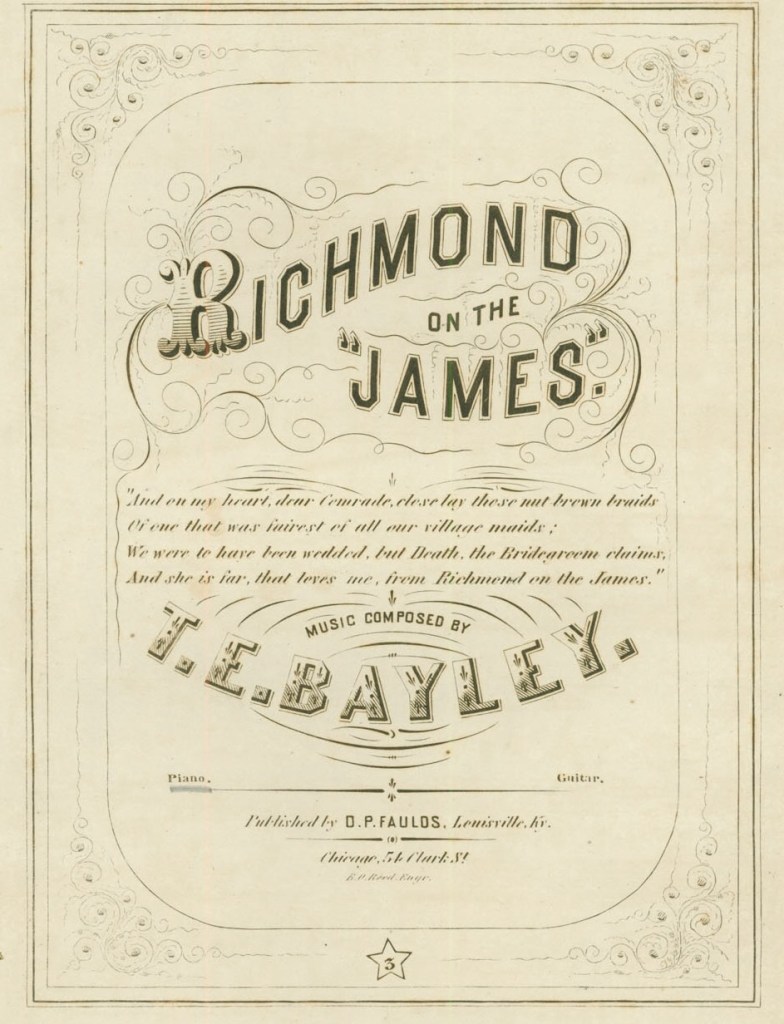
In 1863, the song first appeared, attributed to Kentucky composer, T.E. Bayley. The following year, the music book, “Southern Soldier’s Prize Songster,” published in Mobile, Alabma, printed substantially the same ballad and attributed it to a G. T. Burgess. So while this latter version is not necessarily the song’s birthplace, it is one early stopping place in a song already on the move.
At the center of the song’s story is a young soldier dying near Richmond, in the midst of the War Between the States, while a friend from boyhood remains beside him. He sends his sword home, asks that a lock of hair be given to his mother, remembers his sister, and speaks of the young woman he expected to marry.
Fast forward nearly a century later, in the early 1940s, and the earliest surviving and known recording appears.
The song kept traveling.
Musician Tim Eriksen says he first heard it on a cassette in 1989 and carried the song for years. Anne Hills and Cindy Mangsen also included it on their 1994 album, “Never Grow Old.” Eriksen later gave it to Alison Krauss, who debuted her version in her 2025 album, “Arcadia.”
Krauss has said that hearing a woman tell the soldier’s story makes us feel how young and innocent those men were—and how little they could know about what war would ask of them.
That may be why her performance is so moving and soulful. It does not make the battlefield grand. It draws us close to a son, a brother, a friend, and a promised husband who will not be coming home.
That is the beautiful mystery of traditional music. No generation owns it. One person writes it down. Another remembers it. Another changes a line. Another sings it into a recorder. Another carries it onto a modern album.
Ink becomes voice, voice becomes memory, and memory becomes music again.
A song can outlive the war in which it first appeared. It can cross regions, generations, and centuries and still find its way to a porch, a fiddle, a guitar, and someone willing to listen.
And so, from our #ChuckatuckLife porch to yours… may the old songs never lack a voice to carry them home.


 Fred~on~History