Some people travel hundreds of miles to experience history. Around Chuckatuck, we only have to look across the creek.
From our home on Cedar Creek, we can look toward Mattanock Town, the ancestral home of the Nansemond Indian Nation. It’s a reminder that long before Suffolk existed — long before Virginia appeared on a map — this land was home to the Nansemond people, whose name means “fishing point.” For thousands of years, they lived along the Nansemond River, fishing its waters, harvesting oysters, hunting its forests, and farming its fertile shores.
English settlement though brought warfare, displacement, and centuries of pressure to abandon their identity. Nevertheless, the Nansemond endured — maintaining their families, their community, and their connection to this land through an unlikely marriage between a 17th century English minister and the daughter of a Nansemond Chief. Today, they remain an important part of our community — not just a chapter in a history book, but our neighbors.
My own appreciation for their story began when I was young. My father shared his fascination with local history after spending his childhood walking freshly plowed fields, finding arrowheads left behind by those who called this place home generations before us. Those small discoveries sparked a lifelong respect for the people who came before us.
One memory has stayed with me for decades: meeting Chief Earl “Running Deer” Bass at a Nansemond Pow Wow. I was just a kid, and he was already in his 80s, but I remember him as a kind, gentle soul – and a man who loved Christ. He was fiercely proud of his Nansemond heritage and of his Christian faith — an example that has stayed with me.
In 1988, the tribe held its first Pow Wow back on their ancestral land, calling it the “Nansemond Indian Homecoming.” This weekend, that history comes alive once again as the 38th Annual Nansemond Indian Pow Wow returns to Mattanock Town. Gates open at 10 a.m. on Saturday and Sunday, with Grand Entry at noon on Saturday and 1 PM on Sunday. Visitors can experience traditional dancing and singing, Native arts and crafts, food, fellowship, and opportunities to learn about one of Virginia’s oldest living cultures. Admission and parking are free, though donations are encouraged to support the tribe’s ongoing work.
If you’ve never been, I encourage you to go. It’s a chance to celebrate a people whose story has never ended, and whose roots remain firmly planted right here in our backyard.
Sometimes the richest history isn’t found in a museum. Sometimes, it’s just across the creek. From our Chuckatuck porch where we can still hear the drumbeats of the Nansemond, until next time, that’s another Fred On History Friday.
This has been a tough week, and leaving me further heartbroken is hearing the passing of my friend, Ben Jones.
To millions of people, Ben was Ben Jones aka “Cooter” from The Dukes of Hazzard—a beloved character whose humor, warmth, and unmistakable voice became part of American popular culture. But to those of us who were fortunate enough to know him personally, Ben was so much more. He was a man of conviction and compassion, a gifted storyteller, a loyal friend, and a genuinely kind and gracious human being.
Ben and I first met in 2001, in what now seems like another lifetime. We became unlikely allies in the world of politics. Ben had served as a Democratic member of Congress and, with his characteristic self-deprecating humor, liked to say that he lost reelection because of an illness: “The voters were sick and tired of me.”
That was Ben. He could find the humor in almost anything, including himself. But beneath the laughter was an intelligent, thoughtful man who cared deeply about his country, his history, his friends, and the causes to which he committed himself.
Although politics first brought us together, we soon discovered that we shared common ground in many other ways. We both had a deep affection for North Carolina and Virginia, as Ben was born in eastern NC, but the railroad brought his family to Tidewater while he was still young. He spent a great deal of time in Suffolk, particularly in Driver, where his grandparents lived.
Ben eventually graduated from Woodrow Wilson High School in Portsmouth, before attending the University of North Carolina, where he studied theatre. From there, of course, his journey carried him into acting, music, television, public service, and a place in the hearts of generations of fans.
When Ben and I met, questions surrounding Southern history and heritage were becoming increasingly contentious in Virginia. From that beginning grew a lasting friendship. Together, we lobbied legislators and governors, gave television and newspaper interviews, attended meetings, and spent more hours than I can count talking about history, politics, people, and life.
At the time, I was making my way through college and then law school, while Ben was managing his Cooter’s establishments in Tennessee and Virginia. Our lives were busy, and often very different, but the friendship endured.
After the political tempests of those years had settled, Ben and I continued to reunite from time to time. We saw one another at memorial services and community events, including Driver Days, where Ben and his band appeared on several occasions. Anyone who saw Ben perform knew that he did not merely entertain an audience—he embraced it. He made people feel that they were part of the show and, for a little while, part of his extended family.
One reunion that remains especially vivid in my memory came when Ben was promoting his autobiography at Prince Books in Norfolk. I had the privilege of introducing him to my father and having him sign one of his books. I also had the opportunity to see Ben in a very different and touching setting, surrounded by many of his former high school classmates who had come to see him.
Here was a man who had achieved national fame, served in Congress, appeared before countless cameras, and met people from every walk of life. Yet among his old classmates, he was simply Ben again—the young man they had known in Portsmouth. There was no pretense about him. No sense that celebrity had placed him above anyone else.
There was always a smile on Ben’s face and laughter in his voice, but it was never merely part of a character he played. That warmth was real. His kindness was real. His graciousness was real.
Ben was a true Southern gentleman in the very best sense of that phrase: courteous, generous, loyal, welcoming, and attentive to the people around him. Whether he was speaking to a governor, an old school friend, a fan of The Dukes of Hazzard, or someone he had met only moments before, Ben had a gift for making that person feel seen and valued.
We connected again in 2015, when we worked together during his service as spokesman for the Sons of Confederate Veterans. As before, Ben approached that work with passion, determination, and a deep sense of personal conviction.
During the last few years, distance and the demands of life meant that we did not see one another as often as we once had. But we remained in touch through emails and Christmas cards. Ben would keep me informed about the latest news from “Hazzard County,” and I would send him reports from “old Nansemond.”
And whenever I called, Ben would answer.
More than once, I handed the telephone to an unsuspecting friend. A moment later, that friend would hear the unmistakable voice on the other end of the line: “This is Crazy Cooter comin’ at ya…”
The surprise and delight on their faces never failed to make me laugh, and Ben was always willing to play along. It was a small kindness, perhaps, but it said a great deal about him. Ben understood the joy he could bring to people, and he gave that joy freely.
I will miss those telephone calls. I will miss the correspondence. I will miss the laughter, the stories, the shared memories, and the knowledge that somewhere up the road, my old friend Ben was still holding forth in Hazzard County.
I will remember with gratitude the years we shared, the causes we championed, the places we visited, and the conversations that passed between us. I will remember his courage, his humor, his loyalty, and his compassion for so many people and so many causes.
Most of all, I will remember the man behind the famous character: my friend Ben Jones.
My deepest condolences go to his dear wife, Miz Alma—his true love, his partner, and his best friend. May she, their family, and all those who loved Ben find comfort in the extraordinary life he lived, the countless lives he touched, and the joy he gave so generously to others.
And somewhere in my memory, I will always hear that familiar voice coming across the telephone, full of mischief, laughter, and life: “This is Crazy Cooter comin’ at ya…”
Rest in peace, old friend, and may you continue on to rise in Glory.
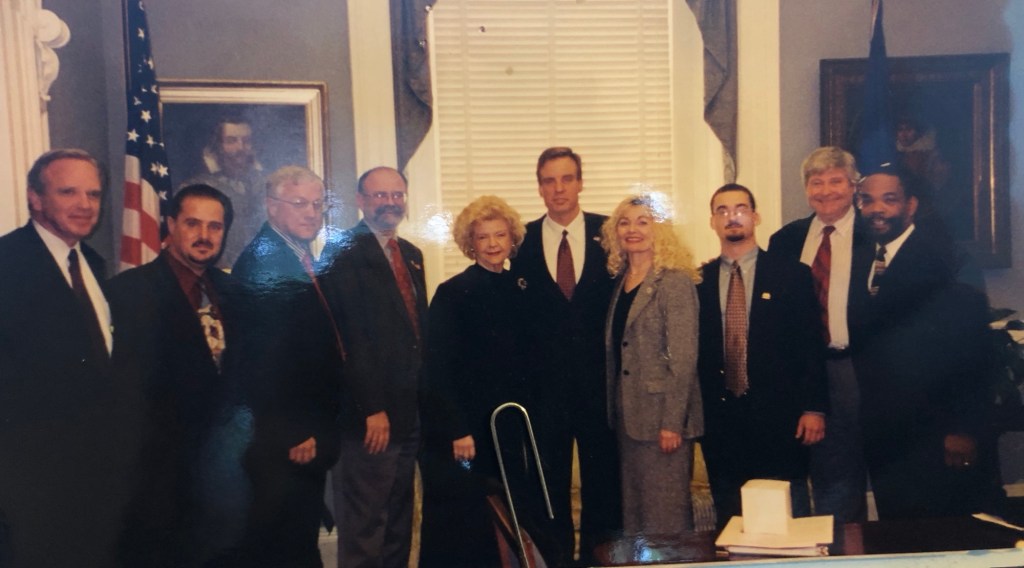
Circa 2002 at the Virginia Capitol during a meeting with then-Governor Mark Warner, with Ben by my side. We made a formidable team.
A day late with our usual #fredonhistory post—but when a song’s story has been traveling for more than a century and a half, one more day seems forgivable.
We love music around here.
All kinds, but especially the traditional songs: the ones that carry names, places, grief, faith, and some trace of every voice that kept them alive. Because of this, I listen to a great deal of bluegrass, and one track – “Richmond on the James” – from Alison Krauss’s latest album sent me down a particularly long historical trail.
Old songs, like old land, sometimes come with a tangled chain of title.
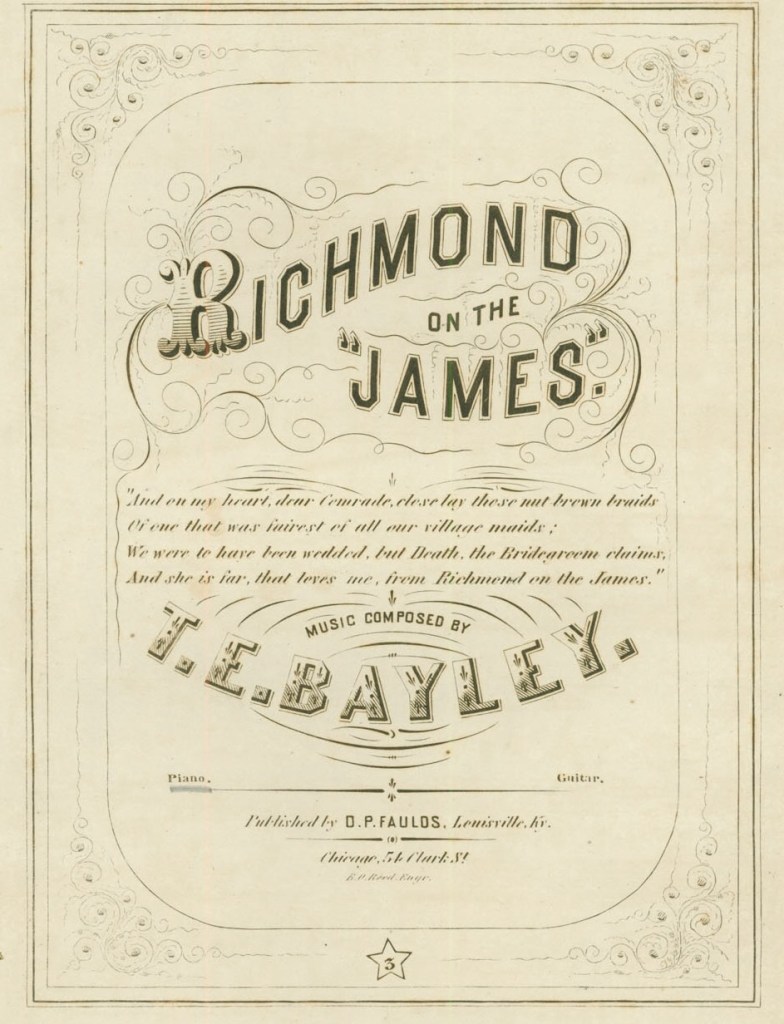
In 1863, the song first appeared, attributed to Kentucky composer, T.E. Bayley. The following year, the music book, “Southern Soldier’s Prize Songster,” published in Mobile, Alabma, printed substantially the same ballad and attributed it to a G. T. Burgess. So while this latter version is not necessarily the song’s birthplace, it is one early stopping place in a song already on the move.
At the center of the song’s story is a young soldier dying near Richmond, in the midst of the War Between the States, while a friend from boyhood remains beside him. He sends his sword home, asks that a lock of hair be given to his mother, remembers his sister, and speaks of the young woman he expected to marry.
Fast forward nearly a century later, in the early 1940s, and the earliest surviving and known recording appears.
The song kept traveling.
Musician Tim Eriksen says he first heard it on a cassette in 1989 and carried the song for years. Anne Hills and Cindy Mangsen also included it on their 1994 album, “Never Grow Old.” Eriksen later gave it to Alison Krauss, who debuted her version in her 2025 album, “Arcadia.”
Krauss has said that hearing a woman tell the soldier’s story makes us feel how young and innocent those men were—and how little they could know about what war would ask of them.
That may be why her performance is so moving and soulful. It does not make the battlefield grand. It draws us close to a son, a brother, a friend, and a promised husband who will not be coming home.
That is the beautiful mystery of traditional music. No generation owns it. One person writes it down. Another remembers it. Another changes a line. Another sings it into a recorder. Another carries it onto a modern album.
Ink becomes voice, voice becomes memory, and memory becomes music again.
A song can outlive the war in which it first appeared. It can cross regions, generations, and centuries and still find its way to a porch, a fiddle, a guitar, and someone willing to listen.
And so, from our #ChuckatuckLife porch to yours… may the old songs never lack a voice to carry them home.