🤍 So… are we wearing white after Labor Day or not?
Labor Day has come, and for those of us raised in the South, that brings up one of life’s great etiquette questions:
Can you still wear white?
Southern Living recently tackled the subject, and while modern fashion says absolutely yes, old Southern habits can be mighty hard to shake.
The tradition of packing away the white after Labor Day goes back generations. White linen, dresses, suits, and shoes were practical choices for hot summer weather and became closely associated with summertime and vacation. As fall arrived, wardrobes traditionally shifted toward darker colors and heavier fabrics — and Labor Day eventually became the unofficial line in the sand.
But somewhere along the way, a practical seasonal change became a rule.
And in the South, we took that rule seriously. 😂
For many of us, “no white after Labor Day” was less about high fashion and more about what Mama and Grandmama taught us. You put away the white shoes, brought out the darker colors, and didn’t question it.
Today, fashion experts generally agree that white works year-round. Cream, ivory, winter white — and, yes, even those white jeans — can all have a place in a fall wardrobe.
Still, traditions have a funny way of sticking with us.
So while my head may say wear the white, there’s a little Southern voice somewhere in the back of my mind asking:
“After Labor Day, though?” 😳😂
How about y’all? Are you Team Wear the White or Team Put It Away Until Easter?
Today we turn the calendar to September, and along with the return to school, football, and the hope that fall may eventually find its way to Virginia, September also happens to be National Bourbon Month.
Now, around The Chuckatuck Life, we don’t need much encouragement to appreciate a good bourbon — but there is actually a little history behind the glass.
We generally think of bourbon as synonymous with Kentucky, and rightly so. But there is an interesting Virginia footnote to that story:
Kentucky was Virginia.
Following the American Revolution, settlers pushed westward into what was then Virginia’s “Kentucky country,” taking with them the tradition of turning surplus grain into whiskey. Kentucky would not become a separate state until 1792. So perhaps Virginia can claim at least a seat at the table whenever the history of America’s native spirit is being discussed.
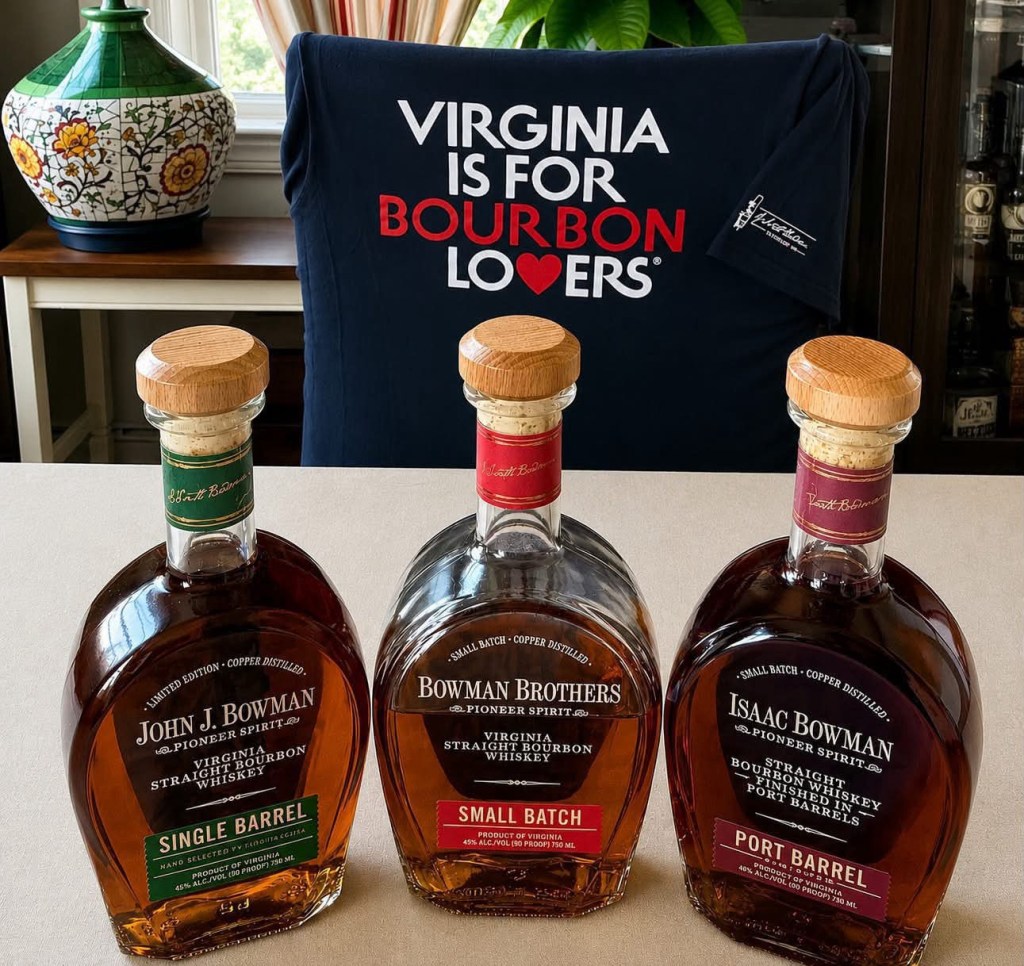
And if you want to turn National Bourbon Month into an excuse for a day trop, put A. Smith Bowman Distillery in Fredericksburg on the list.
Bowman’s story began after Prohibition. In 1927, Abram Smith Bowman purchased a 7,200-acre farm in Fairfax County. With an abundance of grain being produced there, the family entered the whiskey business, establishing the distillery in 1934. The operation later moved to Fredericksburg, where Bowman (now owned by Sazerac) continues the tradition today.
There’s also an interesting Kentucky-Virginia partnership inside the bottle. The Bowman recipe is believed to use a mix of the Buffalo Trace #1 and #2 mash bills. The exact proportions are proprietary, but the whiskey receives its initial distillation in Kentucky before coming to Fredericksburg, where Bowman distills it again and then puts it into new charred oak barrels to mature in Virginia for 8-10 years.
My personal recommendation is the award-winning John J. Bowman Single Barrel.. At 100 proof, it has enough strength and character to be interesting without becoming overpowering, and each bottle comes from a single selected barrel rather than a blend. After first getting that “Virginia hug,” a proper taste will give you notes of toffee, leather, figs and almonds.
Best of all for fellow Virginians, you don’t necessarily have to make the drive to Fredericksburg to find a bottle: Bowman Single Barrel is carried by Virginia ABC, although inventory naturally varies by store.
Still, I recommend the field trip.
The Fredericksburg distillery gives you the opportunity to see how that Kentucky-distilled spirit becomes Virginia bourbon — from that additional distillation through barreling, aging and ultimately bottling.
So sometime this September, pour a good bourbon neat, mix an Old Fashioned, or better yet, take the drive to Fredericksburg and learn a little of the history behind the glass.
Because sometimes learning a little history is best done one barrel — or one glass — at a time. Cheers from Chuckatuck. 🥃
And we’re just getting started. Stay tuned throughout National Bourbon Month as we highlight some of our favorite bourbons, share a few favorite recipes and cocktails, and find plenty of good reasons to raise a glass along the way.
So what is your favorite bourbon, and how do you take it?