Ben Jones, 1941-2026

This has been a tough week, and leaving me further heartbroken is hearing the passing of my friend, Ben Jones.

To millions of people, Ben was Ben Jones aka “Cooter” from The Dukes of Hazzard—a beloved character whose humor, warmth, and unmistakable voice became part of American popular culture. But to those of us who were fortunate enough to know him personally, Ben was so much more. He was a man of conviction and compassion, a gifted storyteller, a loyal friend, and a genuinely kind and gracious human being.

Ben and I first met in 2001, in what now seems like another lifetime. We became unlikely allies in the world of politics. Ben had served as a Democratic member of Congress and, with his characteristic self-deprecating humor, liked to say that he lost reelection because of an illness: “The voters were sick and tired of me.”

That was Ben. He could find the humor in almost anything, including himself. But beneath the laughter was an intelligent, thoughtful man who cared deeply about his country, his history, his friends, and the causes to which he committed himself.

Although politics first brought us together, we soon discovered that we shared common ground in many other ways. We both had a deep affection for North Carolina and Virginia, as Ben was born in eastern NC, but the railroad brought his family to Tidewater while he was still young. He spent a great deal of time in Suffolk, particularly in Driver, where his grandparents lived.

Ben eventually graduated from Woodrow Wilson High School in Portsmouth, before attending the University of North Carolina, where he studied theatre. From there, of course, his journey carried him into acting, music, television, public service, and a place in the hearts of generations of fans.

When Ben and I met, questions surrounding Southern history and heritage were becoming increasingly contentious in Virginia. From that beginning grew a lasting friendship. Together, we lobbied legislators and governors, gave television and newspaper interviews, attended meetings, and spent more hours than I can count talking about history, politics, people, and life.

At the time, I was making my way through college and then law school, while Ben was managing his Cooter’s establishments in Tennessee and Virginia. Our lives were busy, and often very different, but the friendship endured.

After the political tempests of those years had settled, Ben and I continued to reunite from time to time. We saw one another at memorial services and community events, including Driver Days, where Ben and his band appeared on several occasions. Anyone who saw Ben perform knew that he did not merely entertain an audience—he embraced it. He made people feel that they were part of the show and, for a little while, part of his extended family.

One reunion that remains especially vivid in my memory came when Ben was promoting his autobiography at Prince Books in Norfolk. I had the privilege of introducing him to my father and having him sign one of his books. I also had the opportunity to see Ben in a very different and touching setting, surrounded by many of his former high school classmates who had come to see him.

Here was a man who had achieved national fame, served in Congress, appeared before countless cameras, and met people from every walk of life. Yet among his old classmates, he was simply Ben again—the young man they had known in Portsmouth. There was no pretense about him. No sense that celebrity had placed him above anyone else.

There was always a smile on Ben’s face and laughter in his voice, but it was never merely part of a character he played. That warmth was real. His kindness was real. His graciousness was real.

Ben was a true Southern gentleman in the very best sense of that phrase: courteous, generous, loyal, welcoming, and attentive to the people around him. Whether he was speaking to a governor, an old school friend, a fan of The Dukes of Hazzard, or someone he had met only moments before, Ben had a gift for making that person feel seen and valued.

We connected again in 2015, when we worked together during his service as spokesman for the Sons of Confederate Veterans. As before, Ben approached that work with passion, determination, and a deep sense of personal conviction.

During the last few years, distance and the demands of life meant that we did not see one another as often as we once had. But we remained in touch through emails and Christmas cards. Ben would keep me informed about the latest news from “Hazzard County,” and I would send him reports from “old Nansemond.”

And whenever I called, Ben would answer.

More than once, I handed the telephone to an unsuspecting friend. A moment later, that friend would hear the unmistakable voice on the other end of the line: “This is Crazy Cooter comin’ at ya…”

The surprise and delight on their faces never failed to make me laugh, and Ben was always willing to play along. It was a small kindness, perhaps, but it said a great deal about him. Ben understood the joy he could bring to people, and he gave that joy freely.

I will miss those telephone calls. I will miss the correspondence. I will miss the laughter, the stories, the shared memories, and the knowledge that somewhere up the road, my old friend Ben was still holding forth in Hazzard County.

I will remember with gratitude the years we shared, the causes we championed, the places we visited, and the conversations that passed between us. I will remember his courage, his humor, his loyalty, and his compassion for so many people and so many causes.

Most of all, I will remember the man behind the famous character: my friend Ben Jones.

My deepest condolences go to his dear wife, Miz Alma—his true love, his partner, and his best friend. May she, their family, and all those who loved Ben find comfort in the extraordinary life he lived, the countless lives he touched, and the joy he gave so generously to others.

And somewhere in my memory, I will always hear that familiar voice coming across the telephone, full of mischief, laughter, and life: “This is Crazy Cooter comin’ at ya…”

Rest in peace, old friend, and may you continue on to rise in Glory.
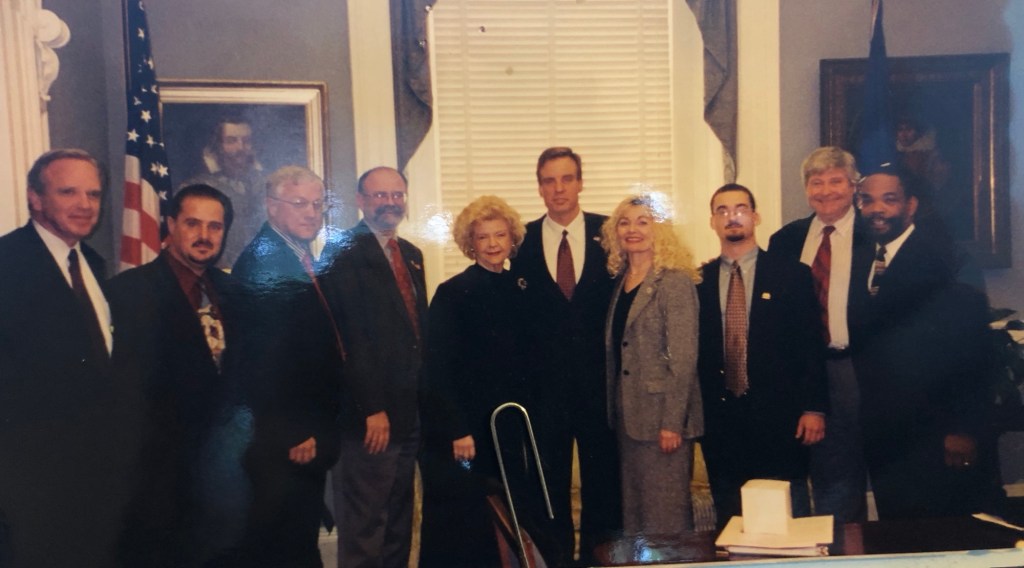
Circa 2002 at the Virginia Capitol during a meeting with then-Governor Mark Warner, with Ben by my side. We made a formidable team.

A Chuckatuck Connection to Pickett’s Charge

Most folks have heard of Pickett’s Charge and the battle of Gettysburg. Fewer know that one of the family stories connected to that famous moment in American history runs right through Chuckatuck.

Meet James Jasper Phillips.

Born in Nansemond County in 1832, Phillips came from a local family tied to the Chuckatuck area. After graduating from the Virginia Military Institute in 1853 — ranked near the top of his class — he returned home and became an educator.

In 1854, he helped establish what became known as the Chuckatuck Military Academy, also remembered as the Chuckatuck Male and Female Institute. Imagine that for a moment: before public schools as we know them today, Chuckatuck had its own school, led by a young VMI-trained teacher, with boys and girls receiving an education right here in the community.

But history soon came calling.

When the War Between the States began, Phillips helped organize the Chuckatuck Light Artillery, a local company of men from this area. Despite the name though, the unit became Company F of the 9th Virginia Infantry. Phillips was elected captain, later rose to colonel, and served through some of the hardest fighting of the war. He was wounded at Gettysburg during Pickett’s Charge, and was later captured at Sailor’s Creek just days before the surrender at Appomattox.

And here is where the family story becomes even more interesting…

James Jasper Phillips was actually the uncle of LaSalle “Sallie” Corbell Pickett, the Chuckatuck-born wife of General George E. Pickett! (… their story will definitely be a future post!) Through the Phillips and Corbell families, our little corner of Nansemond County had a direct family connection to one of the most famous names and moments of the Civil War.

That is what makes local history so powerful.

The great events of history may be remembered in capitals, battlefields, and textbooks — but they were lived by real people from real places. Sometimes, those places are closer than we realize.

Chuckatuck has always been more than a spot on the map. It has been a crossroads of families, faith, education, service, hardship, memory, and story.

And James Jasper Phillips is one of those stories worth remembering.

“Poor Miles… has suffered ten thousand deaths.”

Today, we remember Yadkin County native Miles Melmouth Cowles, Adjutant of the 38th North Carolina Troops, who died on this date, 163 years ago.

Miles Melmouth Cowles, 1861

As Cowles’ full life story could fill numerous pages, this installment will focus only on his wounding and the subsequent days leading up to his death.

Arriving in Richmond in the late spring of 1862, the 38th North Carolina was a relatively “green” regiment. That soon changed, none more so when they marched off on June 26 into what would become the start of the Seven Days’ Battles around Richmond. For regimental Adjutant Miles M. Cowles though, this was not his first test. A seasoned veteran at the mere age of 27, Cowles had served previously as a First Lieutenant with the “Yadkin Grey Eagles,” comprising Company B of the 11th North Carolina Volunteers (later designated the 21st NC Troops) from its organization in April of 1861 well through the Manassas campaign.

Now, Cowles was on the field & staff of the regiment as its chief administrative officer, and spent the months leading prior to assisting with drill and training his young volunteers. Going into the fight though he knew his men were ready for their baptism by fire. Likewise, he and his fellow officers felt a certain security under the watchful eyes of Brigadier General and fellow Tar Heel, William Dorsey Pender, along with their division commander, Major General A.P. Hill.

Describing the start of the battle that would take on many names, to include “Mechanicsville,” “Beaver Dam Creek,” and “Ellerson’s Mill,” then Captain (later Lt. Colonel) George W. Flowers wrote:

“The division crossed Meadow Bridge on June 26th… As soon as the 38th NC Regiment had gotten a little beyond Mechanicsville it was saluted with heavy shelling. A line of battle was formed and the march continued until the order was given to charge the battery that was throwing the deadly missiles. The heat was intense and the double-quick march exhausting, but the charge was kept up over the open field until the regiment reached the summit of the last elevation when a farm house, yard, and garden broke the line somewhat. The Yankee batteries were upon the summit of the opposite hill with their supporting infantry in their entrenchments, and the old field pines in front cut down and piled across the stumps which were left about three (3) feet high, forming an almost impassable barrier. The 38th NC Regiment, alone and unsupported, charged down the hill, the long line of infantry playing upon it with a cross fire. On the soldiers charged, in the face of the fatal volleys, until the obstacles were reached, when the whole line stopped and began returning the fire under every disadvantage. The men were falling rapidly and it was soon seen that to take the works was impossible.”

Picking up from here on the account of Lt. Colonel Robert F. Armfield of the 38th:

“I was an eye witness of the noble gallantry of Adjutant Cowles during that dreadful charge; and as we rushed furiously down the hill-side fronting the enemy’s battery, only about two hundred yards distant, through a storm of bombs, solid shot, grape and canister, and Minie balls, never surpassed in fury on any battlefield, and whilst the wounded and the killed were falling on every side ‘thick as grain before the reapers sick,’ I could distinguish his manly form through the smoke of battle, far in front of everyone else, and I could hear his clarion voice amid the roar of artillery and musketry, cheering on the brave men who pressed after him. Still he was untouched, as if by a miracle; until a retreat was ordered, when, in utter disregard of his personal safety, he rushed to a small portion of our men who had taken shelter in a clump of trees on our extreme right, and who, it seems had not heard the command to retreat, and were remaining behind. He went from tree to tree, admonishing the men to retreat; and whilst thus nobly engaged in endeavoring to save the men from falling into the hands of the enemy as prisoners, he received a flesh wound in the thigh… I met him a few minutes afterwards at the place where the regiment was reformed, still in reach of the enemy’s incessant fire of artillery. He was assisting in rallying the men, apparently unconscious of his wound. I told him he must go to the rear, he replied he could not leave me; and when I repeated that he must go, he took me by the hand, and whilst the tears ran down his cheek, he said, ‘I want to stay with you until the battle is over.’ I never saw him afterwards.”

Adjutant Cowles remained with his men until they had reached safety, under cover of darkness. Though adamant in his refusal to have his wound dressed or leave the field until the battle was over, he finally heeded his commander’s call. Mounting his horse, Cowles rode the several miles back into Richmond, arriving early in the morning of the 27th. He was initially received and treated at the “Kent Hospital” (formerly warehouse of Kent, Paine & Co.), but transferred to a private residence on June 30th.

Sadly, it was said “he never rallied from the shock caused by the loss of blood.” Word was sent out immediately to his family in North Carolina warning of his grave condition. His older brother Andrew C. Cowles, a member of the North Carolina House of Representatives, arrived from Raleigh in just a few days. Another brother, William Henry Harrison Cowles, serving as Captain of Company A of the 1st North Carolina Cavalry, and a nephew Calvin Benham (also of the 1st NC Cavalry), were granted furloughs and joined him soon thereafter.

Adjutant Cowles lingered for days, with his family keeping watch around the clock, ever holding on hope of his survival. A letter to their father on July 8th reported, “Miles, poor Miles, has suffered ten thousand deaths, but today our kind and accomplished Surgeon Dr. Chambliss thinks his symptoms are slightly better,” though warning, “You must prepare yourself for the worst at any time.”

His life was not to be spared though, and at 6:50 PM on July 9th, 1862, Miles Melmouth Cowles breathed his last, his nephew noting, “Miles bore himself gallantly.”

The news of his passing spread quickly to his comrades, with an outpouring of condolences coming in the wake.

Brigadier General William Dorsey Pender stated in his report of the battle that Adjutant Cowles, “nobly maintained his position until after dark,” and in another account that, “he had never seen anyone behave with more distinguished bravery.”

Colonel William J. Hoke wrote: “The heroic gallantry of Adj. M.M. Cowles… in every duty he was called upon to fulfill on the battlefield. During the entire charge he was in front of the regiment nobly urging on the men, and when ordered to retreat, he was the last to leave the field.”

Lt. Colonel Robert F. Armfield: “A purer, nobler, braver spirit than his, never passed from this to the spirit world; and Liberty herself never made a more precious sacrifice, than when she gave his young heart to death for her cause.”

From his nephew Calvin Cowles Benham: “He was generous, kind & noble. And his life has been fully given in defense of his home… Like others he gives himself a martyr to his country. Oh may God bless him…”

After his passing, the body of Adjutant Cowles – accompanied by his brothers and nephew – took the final trip home to Hamptonville, Yadkin County, North Carolina. He was buried at the Flat Rock Baptist Church Cemetery.

A six month old daughter survived him.

Image: 1/6th plate melainotype (tintype) taken by photographer Esley Hunt in Raleigh, circa September 1861. This image composes part of the Cowles Family Collection, courtesy of Fred D. Taylor.

News from the Tar Heel Faces Photograph Project

Private John Dolphin Harris,
Company A, 50th North Carolina Troops

Some updates! A little over a year ago, I announced that we were transitioning and reviewing/revising much of the content from our Facebook page State Troops and Volunteers to a more permanent location. I am happy to report the progress at our website:

Tar Heel Faces

This site was created through Omeka, which is a web-publishing platform used for the display of library, museum, archives, and scholarly collections.

The site not only allows us to share images and stories, but also is much more user-friendly for research purposes. A full word/phrase search engine is included, and images can also be browsed by a topical tag. For example, if you want to find soldier images from a particular County or Regiment, we now have that capability. Additionally, you can directly submit your own images and stories for inclusion.

I could go on and on about all of the bells & whistles of the site, but I encourage you to take a look and find out for yourself! Likewise, let me know what you think, or any recommendations you may have for improvements.